
Suspending what’s in here and seeing what’s out there

What I’ve found most interesting in the research on key skills for the future world of work is the increasing focus on the more “human”, or at least non-technical, abilities. These include things like empathy, social and cross-cultural literacy, flexibility, openness and lifelong learning. All of these have a core component of mindset – how we approach and relate to others, the world, and especially to otherness, newness and predictability. And while you might argue that it’s more of an attribute than a skill, curiosity might just underpin most or even all of these capabilities.
Curiosity has gained considerable attention recently, not just in the field of education but in business and economics. Harvard says it is essential for ensuring career sustainability in an economy of growing automation. Many other articles highlight curiosity as an essential workplace skill or future-proofing “superpower” (see here and here; also there are ways you can develop your curiosity – see for example Future of Work Academy). And the World Economic Forum has placed great emphasis on giving people the tools for lifelong learning (see here), further suggesting that curiosity – which surely can be seen as the desire to keep learning – helps people make the career shifts necessary to keep up with the digital age.
Curiosity says we should place greater value on questions than answers; on seeking understanding rather than making assumptions; and on challenging the things we take for granted every day.
A closely related idea is that of “beginner’s mindset”. Derived from the Zen concept of Shoshin, it essentially means approaching our experiences with openness, eagerness and a lack of preconceptions. In other words, seeing the world – including everyday things, things we’ve seen thousands of times before, and even things we’re experts on – as if through the fresh eyes of a child.
This kind of mindset allows us to question and reassess deeply held assumptions and hence challenge the status quo. It allows us to see things and open up possibilities that we or others might otherwise miss. These are things that leaders in particular need to do to ensure their organisations and businesses stay relevant, future-focused and innovative (see this Deloitte article).
The problem? It’s not so easy to do.
Fully committed to not knowing
Being human (human adults, to be precise) presents us with two challenges to this kind of open, eager, childlike mindset. First, we’re biased towards certainty; second, as creatures of habit we miss so much of what’s around us all the time (often in favour of the manufactured “novelty” of the online world. How many cat videos are there out there, really?).
The first point – that we have a preference for certainty – should be surprising to nobody in the real world. We are all aware, some more so than others, of our need to have all the answers, all the solutions. It is a pressure we inflict on ourselves and more importantly project onto our leaders.
As long ago as the early 19th Century, the poet Keats described something called “negative capability”, which he defined as the capacity to be “in uncertainties, mysteries, doubts, without any irritable reaching after fact and reason”.
Does that not resonate beautifully with the discipline of science and inquiry? In its quest for knowledge by rigorously testing ideas and hypotheses, science is in fact founded on the commitment to not knowing – or at least, not assuming knowing. With gratitude to Nathan W. Pyle’s Strange Planet comics:
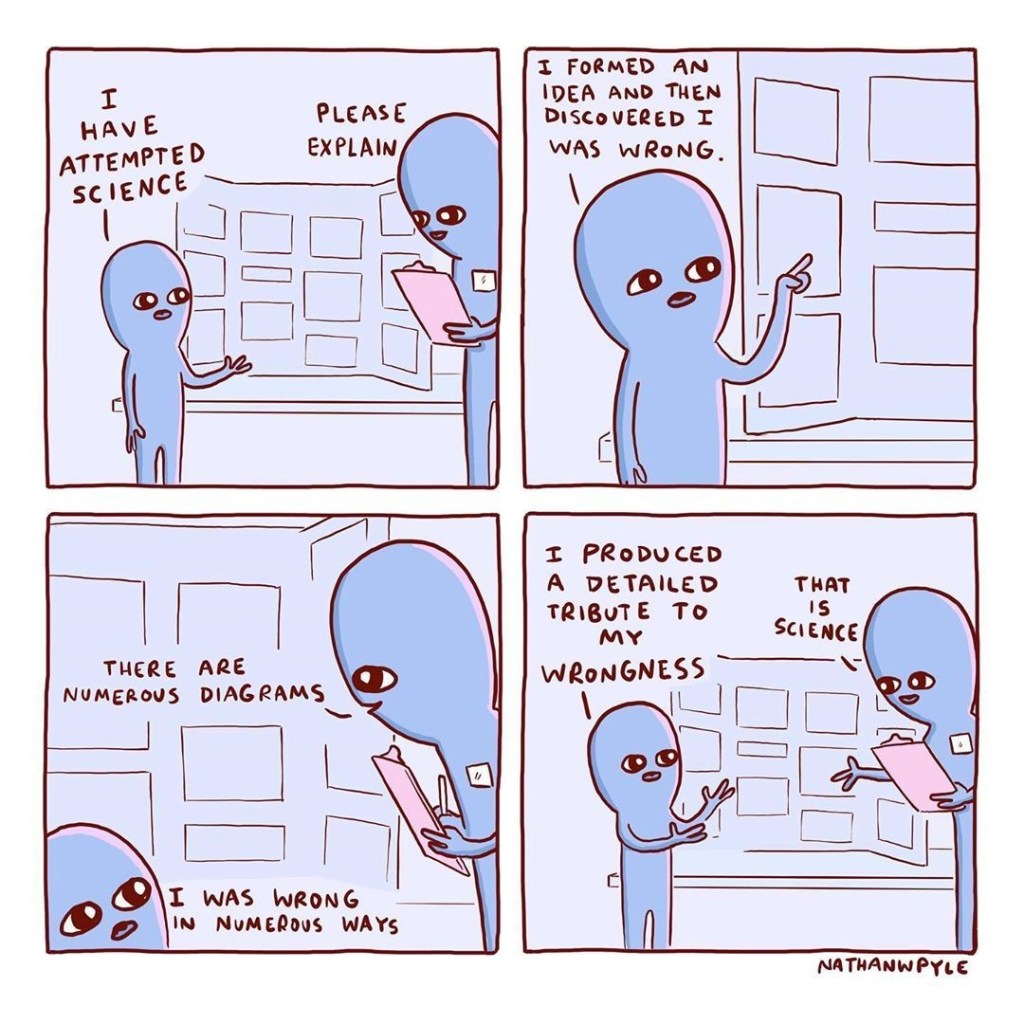
In other words, to be a scientist – which I think is the same as being professionally curious – you have to develop your “negative capability” and be able to tolerate uncertainty. More than that, to embrace uncertainty. (In my mind, the moment we assume we know everything, science is effed.)
Keats’s “irritable reaching” is just the thing – not knowing equals discomfort. It’s uncomfortable because we fear the unknown, not just because it’s scary but also because grappling with something unknown or new or just different requires extra effort.
Habits and the efficiency of autopilot
So how often do we operate from a need for certainty? Whenever we run a “program” in order to function on a day-to-day basis: in other words, through our habitual ways of acting and responding.
“The efficiencies of the adult mind, useful as they are, blind us to the present moment. We’re constantly jumping ahead to the next thing. We approach experience much as an artificial intelligence (AI) program does, with our brains continually translating the data of the present into the terms of the past, reaching back in time for the relevant experience, and then using that to make its best guess as to how to predict and navigate the future.”
Michael Pollan, How to change your mind.
Habits are useful because they spare us from performing complex mental operations for every single mundane task we’re faced with. They offer efficiency. The downside, of course, is that as we move through life we place more and more of our experiences into a sort of “shortcut” frame, operating or responding on autopilot, which means that we aren’t fully present and aware of the experience. When you habitually read your news feed while eating lunch, you don’t taste the food; when you drive the same route to work, you don’t really see anything you pass by on the road.
As Michael Pollan adds, habits “relieve us of the need to stay awake to the world: to attend, feel, think, and then act in a deliberate manner. (That is, from freedom rather than compulsion.)”
Of course, our “autopilot” responses can also be pretty unhelpful, even perpetuating our baseline stress levels, and yet we continue them purely because they’re familiar – hence, perhaps, providing a perverse sort of “certainty”. Think about how we habitually respond to situations like being stuck in traffic. We allow it to irritate us; then before long, we anticipate the irritation and it becomes a reflexive response.
Speaking of reflexive negative responses, I’ve tried to use curiosity to relieve irritation caused by one of my personal triggers: other people’s noise (yes, that’s me in the “hypersensitive” corner). Specifically, I’ve tried to understand what’s causing the noise in the hope that this will “soften” my response. My attempts included Shazamming the song that was grating my ears in a coffee shop, and trying to mentally empathise with a person who was sniffing because they had a cold (Note: this was BC – Before Corona).
What if you applied the same approach to being annoyed by traffic? You could become curious about the people in the cars around you, observing traffic as an indication of productivity, of people going about their lives. You could even observe that you yourself are part of the traffic.
I can’t say my own efforts were entirely successful at making me less irritated. At the very least, they gave me a distraction, something for my brain to do instead of just be irritated – but while this might have made me less tense, it didn’t necessarily make me less distractable. This brings me to my next point, which is how we might relate curiosity to mindfulness, and how mindfulness can help.
Seeking certainty versus mindful curiosity
As we know, being on autopilot can lead us to miss things, miss others, even hurt ourselves. To me, “on autopilot” is the opposite of mindful as well as the opposite of curious. But I think an important point to add here is that curiosity is about a quality of attention rather than a sure-fire technique to get to solutions (although it is the starting point of all insight, innovation and breakthroughs).
There is a difference between wanting to understand something and needing to have certainty about it. One can be curious, but in a way that drives too hard for the questions to be answered – worse, in a way that projects anxiety and provokes resistance. This can even be unintentional – I think of myself as curious, and was once given the feedback that my constant questioning sometimes came across as a total intolerance for uncertainty, whereas I thought the opposite. It seemed my being the proverbial three-year-old – demanding to know “Why?” about everything – frankly got people’s backs up.

(On this, I would also be extremely wary of cultures that are patently intolerant of curiosity. The extreme form of this is stifling and a sure-fire way of killing innovation. There is an excellent quote by Richard Freyman:
“I would rather have questions that can’t be answered than answers that can’t be questioned.”
Richard Feynman
Also, as Bertrand Russel said, “Never try to discourage thinking for you are sure to succeed.”)
But perhaps curiosity and mindfulness, which I think clearly overlap, should work together; or put differently, mindfulness can be a useful or even necessary starting point. Mindfulness in itself, of course, isn’t about inquiry – when you practise formally, you don’t start asking questions about your moment-to-moment experience. Rather, you open to it, observing it, seeing it for what it is – and withholding judgement. By that logic, mindfulness can help us actually see what’s in front of us, without the compulsion to do anything about it (yet); hence, allowing us to be curious without being fettered by the ego’s desperate need for solutions, answers and closure.
So what are some things we can do to incorporate curiosity in a mindful way, to suspend our habitual responding?
- Practise just noticing – on your commute, actually notice things passing by. If your drive allows it, simply have a look around. Or simply become more aware of your breathing, your posture, possible tension in your muscles as you hold the steering wheel etc., every time you get to a red light.
- Ask “What can I learn from this?” in difficult or even routine circumstances. This is also about suspending self-judgement.
- Get comfortable not knowing – Practise thinking of a challenge or conflict you currently have, and deliberately surface all the assumptions you are making about how things “should be” – and how they should be. Then, literally try not knowing (what the outcome might be, what the other person’s story is, etc). It might be a relief that you don’t need all the answers. (For more here, see Jack Kornfield’s practice on “The “Don’t Know” Mind).
- Value questions over answers – In meetings where you really do want people’s insights and inputs, ask “What questions should we be asking about this [situation/problem/opportunity]?” (Useful sidebar: From a social perspective, Harvard research has found that people like people who ask questions.That’s good news for introverts, who can score huge points as natural listeners.)
- (For me especially) Be mindful about how you ask questions (in other words – and I’m talking to myself here – watch yourself when possessed by curiosity). Regular mindful practice, before your day or even in small breaks in between meetings, can help you to be calm and deliberate, to phrase and time your questions judiciously – so that people don’t feel bombarded or pressured.
Doing all this – opening up our mindset – is hard because at the end of the day we all want a sense of “home”, and for many of us that’s “zoning out” (i.e. Netflix). But a better kind of “home” could actually be a “reset” to the present moment. It feels like more effort at the start, and it is – more specifically, stepping out of “autopilot” is effortful – but it’s more genuinely refreshing. And also, with just a little practice, you will find you can “come home” anytime.
It goes without saying that our world is growing increasingly uncertain. At the same time, the system wants to hack your brain and make you as predictable as possible. So ask yourself: who’s really in charge? Who’s really awake? Would you rather be hackable, predicable? And would you rather blow up every time there’s any uncertainty in your world? (Or, worse, keep habitually blowing up because at least there’s certainty in it?)
Isn’t it refreshing that in order to gain insight, to get to breakthroughs, we might just need to drop everything rather than know everything?
 All & None of the Above