
Coming to your senses through Open Awareness

I have a confession. I’ve heard the saying: “If you can’t go outside, go inside” many times these past few weeks, and I’ve started to take issue with it – surprisingly, perhaps, given that I’m an introvert.
Let me be clear. I’m not denying that inside, as in physically indoors, is where we should all be right now for the sake of humanity and saving lives. I’m also not denouncing the value of reflection, introspection, self-care and recreation – I live on those things, and am profoundly grateful to have the space to do so. In theory, going inside is something I should be first in line to sign up for.
But what I have noticed personally is a particular resistance to the mantra of “going inside” as a way of finding perfect solace, and as a guarantee of finding all the answers. I am naturally introspective and can spend hours journaling (this blog should hint at that), but as an overthinker I have come to realise the value of not taking my inner confabulations too seriously. In my mind, the truth may be deep within, but so is a whole lot of bullshit stories and distorted reality. I will go properly inside with the help of a qualified therapist, or I will look at whatever I find there from a safe and neutral distance and take it all with a (hopefully self-compassionate) pinch of salt.
In short, my personal experience is that being “in here” can be a sanctuary but it can also be profoundly distressing, frustrating, and noisy.
Why living “out there” is actually mostly living “in here”
In mindfulness meditation, we are often told to close our eyes at the start of a practice in order to gather our senses and shut out distractions, or at least just the visual field. At the end of the practice, we might hear: “Come back into the room”.
This might suggest that in our everyday functioning we are operating “out there” in the real world, and when we want to meditate we need to move our focus “in here”, to our inner world.
I would argue that in our everyday functioning, we are hardly ever out there in the real world. More often than not, we are inside – so deep inside our own worlds that we don’t actually realise it’s not reality. Time moves differently there – we time-travel much of the time, analysing and replaying events that happened in the past, or planning and worrying about what will happen in the future.
If we’re not in our individual internal world of thoughts, we are in the online world, which once again is not present reality but more importantly to me feels like an inside space because it engages our minds so fully.
I’ve also found that now that the social world has become almost exclusively digital, it’s gotten noisier as well. I think one of the reasons for this is that in “analogue” present reality, there can be a limited number of streams of input – basically, whatever we perceive through our senses – whereas in the digital world, several streams of information are coming in at any time. Socialising in the analogue world can be noisy, but there’s still only one place you can be at once. Socialising online is a different story: several people or groups are talking at once on WhatsApp, and you can simultaneously be in other virtual meeting spaces. And it’s happening on top of the dozen or so tabs you have open on your browser. And, of course, everything is engineered for us not to be willing to wait to get an answer or put out a response.
So the online and digital world, which feels like an extension of “inside”, is noisy because it’s like multiple worlds at once. I like to stay in one world at a time, and experience what I think of as a 1:1 reality ratio. And I find the only way to experience this is when there are no devices in sight.
That may seem like a very long-winded way of explaining the magic of digital detoxing. But here’s where it gets back to mindfulness practice.
“Outside inside” – Coming to your senses
I’ve hinted at the fact that “inside” is not, in fact, a place I always want to go. And that this is more about wanting to get out of my head than out of my house. I want to be outside, but in a quiet space – a sort of outside-inside buffer zone, an analogue refuge. And the way I’ve found to do this is through using the senses and a style of meditating called open awareness.
Here are two techniques I’ve learned to come back to present reality through the senses.
Count Down to Present Reality in 5, 4, 3, 2, 1
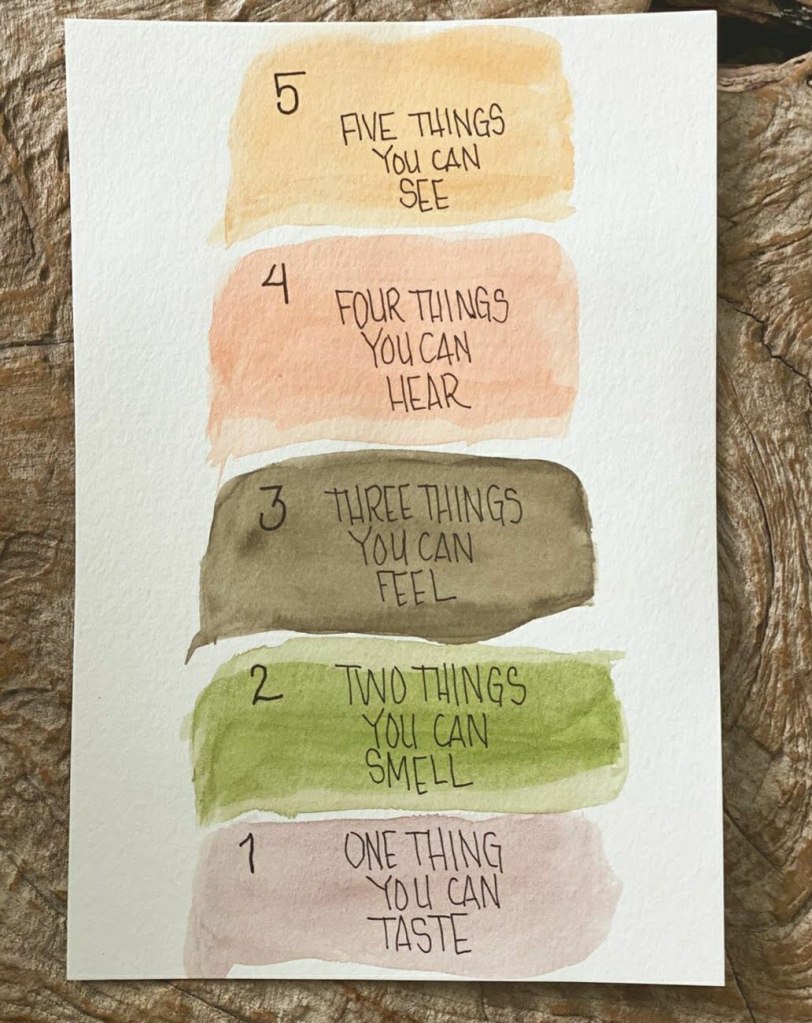
The first is something I discovered on Instagram, shared by writer Elizabeth Gilbert, called the 5-4-3-2-1 technique. In essence, you pause where you are and take note of: 5 things you can see, 4 things you can hear, 3 things you can feel, 2 things you can smell, and 1 thing you can taste. It’s nice to do while in transit or waiting in line (for example, which idling in the queue at the pharmacy), as a breather after doing a lot of thinking work, or as you sit down to a meal by yourself and would ordinarily reach for your phone. The nice thing about the latter is that it helps you find things to smell and taste.
Here it is in graphic format. It’s altogether a nice “mini-reset” that you can try several times a day to slow down and come back into the room.
Open Awareness Meditation
I’ve become used to a style of meditating that is about the opposite of withdrawn, single-pointed focus. Yes, it’s about sitting quietly and being still, but it’s not about shutting out sensory distractions. It is, in fact, almost about focusing on everything at once – just without engaging with any detail. It’s called open awareness.
In this style of meditating, or at least the Tibetan version I learned recently and am adapting here, you keep your eyes open. You keep every one of your senses open, in fact. You stay open to every stream of moment-to-moment experience, everything happening right now in present reality. And this includes thoughts.
Brain farts all day long
One of the tricks to this technique, or at least how I’ve interpreted it, is that you can learn to treat thinking almost like another one of your senses. And I’m not talking about a special Sixth Sense with capital letters, even though human thought is of course highly sophisticated. I’m talking about a sixth sense in the most neutral, unremarkable way possible; as an everyday, automatic function that’s no more special than any of the other senses. As in: you can see, hear, feel, taste, smell, and brain.
How are you encouraged to react to sounds you hear while meditating? Ideally, you don’t block them out; rather, you notice them and then you come back to your breath or other point of focus and keep going. You don’t judge your ears for hearing – that’s what ears do. You can do the same with thoughts. You treat them as a product of another organ – your brain. You don’t judge your brain for thinking – that’s what brains do.
What’s particularly helpful about treating thoughts as just another stream of present sensory experience, is that you begin not just to notice them but to notice that they happen all by themselves. You don’t have to engage with them, but you also don’t have to explain them, or understand where they came from, or take any responsibility for them whatsoever, provided you let them go. See them simply as a product of brain metabolism.
Noticing how the body responds
If you can notice thoughts as happening all by themselves, you can also take the step of noticing how your body experiences them, much as you might notice how your body responds to other stimuli like sounds.
I have started doing the latter because I’m particularly sound sensitive. So the challenge has been to move from needing to have a meditation space where I won’t have any noise distractions, to being able to sit there listening to whatever I can hear, be it Instagram stories, family members arguing, or the steady hum of the fridge (we have an impressively loud fridge. I can hear it in the loft through the floor). It’s not “attentive listening”, not listening for content, but it is being aware of the sounds and staying open to the physical sensations that may spontaneously occur in response to them. Of course, it’s nicer to be able to hear soft and calming noises like birdsong, but the idea is to listen without engaging, judging or resisting. And if your brain does engage with the sounds, you simply notice that happening as well.
Noticing how your body experiences thoughts, by the way, could be a useful step in being able to pinpoint how we attach emotions to thoughts. Remember that your body cannot tell the difference between an actual threat (like a burglar with a gun) and a perceived threat (like a stressful thought, or memory). One of my key insights in learning about anxiety, is that we can get anxious about anxiousness itself. A story for another day.
Sitting back and watching the show
For me, then, being “outside inside” is about being able to observe everything that you are experiencing, both outside and inside yourself, from the tingling sensations in your fingers to the ear worm you’ve had stuck in your head since this morning, at the same time. It’s observing your entire field of awareness simultaneously. And importantly, this is a soft focus rather than a laser focus. It’s almost a non-focus – which is why this is also referred to as “non-meditation”, or simple “fresh wakefulness”.
Of course, your focus is going to shift. It’s hard to stay open to sensations and sounds and thoughts at the same time in a perfectly balanced and neutral way. Your focus is going to be uneven and wandering and frankly all over the show. The key is not to try and force it to look like anything. This is not Strava Art for your brain waves.
Stability comes from your vantage point, not your point of focus
And so, what you notice when you do this is that even though you are being still, nothing is still. Your field of awareness is filled with phenomena that are in constant motion – changing sounds, shifting sensations, and flowing thoughts, with or without stories attached to them. By observing moment-to-moment experience and never fixating on any one particular moment, you are in effect watching the moment itself, which never sits still. The only constant is the movement – and, perhaps, the vantage point of awareness from which we observe.
There are a few useful, classic analogies for this:
Mind like the sky, while thoughts and sensations and experiences are the clouds. Clouds never stay the same; they grow or shrink, precipitate or disappear. Open awareness is moving from observing the movement of the clouds to becoming aware of the whole sky; the backdrop.
The observer sitting by the riverside, where the river is the flow of thoughts, feelings and experience. The river is never still; the water molecules that flow past are each different and swiftly changing, but they are part of one entity – the river. Open awareness is moving from focusing on the water molecules to becoming aware of the river – and of the observer on the bank.
The waves being part of the ocean. The waves are our thoughts and experiences. Open awareness is moving from watching and even trying to calm the waves to becoming aware of their rhythm and seeing the ocean.
It’s about recognising stability in constant movement; stillness in flow. It’s like catching hold of a thread that is the present moment, and that keeps going.
 All & None of the Above