

There’s a joke about how we like to think of our bodies as a vehicle to carry our brains around. It used to go that our bodies were just there to take our brains to meetings, but of course nowadays they often go only as far as the laptop in our home office – perhaps making them even more of an inconvenience, if not ever more inefficient. We probably either know someone, or are guilty of being that someone ourselves, who forgets they have a body for several hours at a time, realising at 3pm on a work day that they haven’t fed themselves anything since that second cup of mid-morning coffee (or was it the third?).
In short, we live in our heads, particularly those of us working in the so-called knowledge economy, but I would say anyone who regularly accesses a screen and engages with any form of digital reality. It seems, in fact, that we believe we are what’s in our heads: that we are our minds.
Now, most of us would naturally assume that the seat of the mind is the brain. But when confronted with the possibility of being a brain? Not so easy. Easier to imagine a replica of yourself. In your head. Simply put, we think there’s a mini-me in our heads.
Mini-Me, you complete me*
I first came across something called the homunculus theory in a psychology class during my university days. It’s admittedly obscure – the only thing I could find about it on the first Google search results page was this (dated 1997!) – but it obviously stuck with me. I was reminded of it again recently when I was being guided through a common mindfulness practice known as the body scan.
This practice typically involves a sequential “walk-through” of the body: you move your attention from your feet up, through the lower to upper body and all the way to your head, or the other way around, but always in a logical anatomical order. This version added something extra: we were invited to imagine the body as a house and to visualise ourselves walking through it, exploring its various metaphorical rooms, passages and stairways. I was struck by how much easier this was than a regular body scan, and was surprised by this at first, until I had a realisation: the house metaphor works because of the homunculus effect.
What is a homunculus? A representation of a tiny human being. Who’s walking through the “house” in the body scan? Your Mini-Me. Now, of course I’m not saying there’s a literal humanoid, doll-like figurine inside our bodies, wandering around Alien style. I’m saying we usually cannot perceive physical sensations and stimuli, and even thoughts and feelings and memories, without simultaneously visualising the subject (i.e. ourselves) doing the perceiving. We never picture disembodied sensations; there’s always a representation of the self, the “I”.
Or, put differently, it’s hard to move abstract attention around our body, so we bring our imaginations online and use a metaphor to make it feel more concrete. Some body scan techniques use the image of a spotlight; this one used a miniature home viewer.
What’s the upshot of all this? Basically, we walk around with an imagined self which is a replica of, in control of, but completely separate from, our physical self. This is the homunculus, the Mini-Me pulling all the levers while looking out from the seat of our heads through the eyes. This is, essentially, our centre of the universe. What does it all mean and where does it all come from?

Photo by Ibrahim Boran from Pexels
Who’s telling the story?
To me, one insight that this phenomenon offers is that we struggle to imagine anything without imagining somebody either doing it or observing it. We have to cast actors, as it were – a protagonist, a hero, and an observer or narrator. I think this has something to do with the fact that we think in stories and in words, something which is difficult to shake even when we aren’t thinking particularly hard about anything.
I’ve become very much acquainted with my “internal narrator” during meditation practice, noticing how often I “hear” myself telling myself what to focus on (“Let’s start with sounds outside, and then we’ll narrow down to the breath…”). I’ve sometimes wondered whether it’s possible to think something, or rather do something mentally, without words forming simultaneously in my mind (and then of course got caught up wondering what other part of me was doing the wondering). But the key idea is that because there seems to be constant commentary in my mind, an inner commentator is implied.
Perhaps the bigger question is, is consciousness possible without a commentator, without a subject? We clearly have the impression that there is something – personified or not, incessantly chatty or occasionally quiet – that is bigger than our bodies, our brains and perhaps even our minds.
Casting ourselves as the protagonist of our own fictions: The Strange Loop phenomenon
You might ask, but what if there isn’t anything else? What if we are just our bodies after all? Or, to use adapted neuro-speak, what if consciousness were just an epiphenomenon of our neurological processes, something engineered by our brains? That’s sort of what polymath and Pulitzer Prize winning author Douglas Hofstadter considered in his “strange loop” hypothesis (a concept developed fully in his 2007 book, I Am a Strange Loop).
I can’t claim to do any justice to the full detail, so I recommend this video, which is based on Hofstadter’s work (and which, incidentally, also contains an Austin Powers reference). Here’s an attempted précis:
- We can know ourselves in two ways: as a whole (a personality, a life story, a bundle of interests, hopes and fears and tendencies) or as an entity made up of parts (trillions of cells, each doing their own thing). The parts-self is physical and concrete; the whole-self is an abstraction, or complex symbol, in Hofstadter language.
- If we were to think of ourselves at the micro-level, as our smallest parts, the detail would be incomprehensible and we would frankly go nuts trying to process it all.
- Therefore, we tend to favour wholes over parts (hence, we see words and pictures, not pixels and shapes and colours).
- Our bias towards seeing the “big stuff” over the “small stuff” creates an illusion of downward causality. I.e. the big stuff causes the small stuff.
- Hence, when something happens in which we are involved, we find a way to attribute it to our own action or influence. We cast our abstract selves (“big stuff”) as the main actors in control of all the “small stuff”.
This ultimately translates into Hofstadter’s self-referential “strange loop” of imagined downward causality. Take the example, mentioned in the video, of “making someone laugh”. If we were to break this idea down, we might imagine a sequence of events in which you said something, your friend heard it and it reminded them of something from a movie they once saw, which triggered a funny memory from childhood, and then they laughed. Therefore, it isn’t technically true that you made them laugh – there were all those missing steps in between. But it would be impossible for us to comprehend all the micro-processes happening all of the time and so, basically, our brains fill in the gaps.
To sum up, the self is an emergent property, which from the bottom up is made up of seemingly random and chaotic process, but which is represented in our brains as something stable. This happens early on in life – by the time we are about five years old, we have cemented our identity into a solidified whole (the “locking in of the “I-loop”).
The question is not who you are, but where?
How is it that we are even able to imagine ourselves as our bodies without ever seeing all of them first-hand?
Think about this for a moment: You never actually see your ears, you only ever imagine them. To explain: you know where your ears are because of the invention of the mirror. Not only that, but somebody taught you once upon a time that those things on the sides of your face are called ears. You can reach up and touch your ears, but the knowledge of how they look and where they are located on your body is, in fact, a hallucination: an imagined image, refined over time by seeing your reflection and then matching the seashell-shaped things in the mirror with those fleshy bits you can feel with your fingers. You have been taught to internalise your reflection, to map physical sensations to an aggregated image which is based on what others see – not what you see in the first-person (that is, without a mirror).
In short, we identify with what others see, from the distance of another person, or a full-length mirror. Whereas Richard Lang, who brought us The Headless Way (which I’ve referred to in previous posts), asks the question: Who or what are you at zero distance?
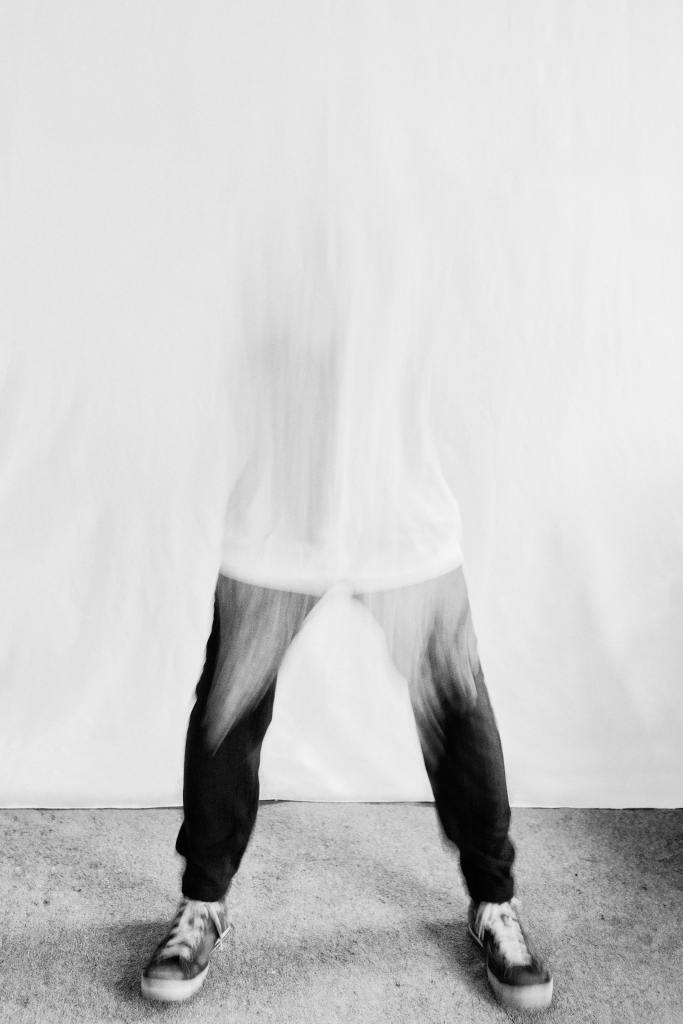
Zooming in and spacing out
From others’ perspective, you are a person. But if you were to move closer and keep zooming in, you would see that you become cells, then molecules, and finally not much at all apart from empty space. The Headless Way invites us to take this perspective, to look out as if from the empty space that is at our core. And it turns out that imagining yourself this close-up has the wonderfully paradoxical effect of making you feel, well, completely zoomed out.
The key is to question the boundaries between “you” (flexibly defined, as we’ve established, depending on one’s perspective) and the rest of the world, and to realise that if you are essentially space, and if there’s no definitive boundary between your space and the space that contains everything, then essentially your space, your consciousness, contains everything in it.
From this perspective, you are not in your mind – you contain it. You aren’t in your head – your head is in you.
Mind = blown? That’s also something you can contain, along with all the other feelings and thoughts and sensations that are arising from moment to moment in your consciousness. The implication is that anything that happens to us, whether positive or negative, from disturbing thoughts and feelings even to bodily injuries, is not us but part of us, or contained within us – while the space, our essential nature, remains unchanged.
This can extend to recognising that we contain everything happening outside us as well. We can be space not only for our own hopes, fears and suffering but for that of others too. In essence, your consciousness is boundless space and everything is just appearing in it.
Harding goes on to say that your consciousness is the consciousness – there is only one. This is, of course, another story. But I will say that Harding isn’t alone.
(*With apologies to those who haven’t seen Austin Powers.)
 All & None of the Above