

To me, a question is the one of the most beautiful devices created by humankind. A request, on the other hand, might just be one of the trickiest. To ask a question is to open and step boldly out the door; to make a request is to stand at the threshold not knowing which way the door will swing. We describe questions as being either open or closed, and a request is usually the latter type. In my case, I experience them often as being not so much closed as foreclosed. That is, if I can get them out straight.
My challenges with requests came up recently when I attended a series of courses on Non-Violent Communication (or NVC). NVC was developed in the 1960s by the late Marshall Rosenberg, PhD, whose talks (you can find several on YouTube) often co-starred two hand puppets: Jackal and Giraffe, each representing a different style of communication. The courses were small and intimate and the subject matter was highly relatable – familiar, even, because it seemed to follow naturally from material I’ve been exposed to time and again: empathic listening, identifying feelings and using what seemed to be a variation on “I” messages, all as part of an communication strategy that supports connection and compassion.
One aspect of NVC which sets it apart, however, is how it directs our attention to identifying the needs behind our feelings. An important NVC principle is that needs are universal: we humans come into conflict with one another as a result of the different strategies we use to get our needs met, but underneath it all, those needs are the same for everyone: love, respect, security, and so forth. And here’s what is interesting: “and so forth” turns out to be quite a long list. Reading through the double-sided page of needs provided as part of the coursework, I was struck by just how many there were.
When doing any training related to EQ, a classic step is learning to expand one’s emotional vocabulary, and by being given a list of feeling words, you suddenly discover how much nuance there is; just how many shades of emotion exist on the spectrum between awesome and awful. NVC goes one step further by offering a similarly expansive repertoire to help us recognise the nuances of our needs.
So then the challenge: In practice, how often can we accurately recognise what we really need? It’s all well and good to have the vocab, but can we accurately discern what specific need is driving our feelings, thoughts and behaviour at any given point? If we’re not so great at putting our emotions into words, how much more do we struggle when we take the next step and try to pinpoint what we need? Not want (which may seem to be “fried doughnuts and retail therapy”) but need (which may be “stability, equanimity, and probably a good night’s sleep”)?
Identifying what I want is a struggle on many days (and, come to think of it, the feelings are still a development area). But I think identifying what we need is further complicated by the emotional vulnerability and baggage that come not just with acknowledging what we are truly seeking beneath our feelings (for, according to NVC, every difficult feeling points back to an unmet need), but also with admitting that we have needs in the first place.
To admit to having needs is to admit to being vulnerable – that is, to being human, and to relying on other humans. It’s perhaps easier to express what we want, at least partly because wanting is something that the world keenly capitalises on, commodifies and even engineers. “I want” also conveys a sense of greater self-confidence and agency than “I need”; it assumes we are after something that’s not on Maslow’s hierarchy.
Many of us learned to suppress our needs as children, in formative relationships with caregivers, and even in or extending to romantic relationships in adulthood. Attachment theory will have plenty to say about this, which I won’t go into here, even though I appreciate much of it.
And then we come to the act of asking.
Asking for a friend

If having a need is a risk in itself, then, to me, asking for what we need presents a double risk. As soon as we ask for something, the door is open and the ball is in the other person’s court, and we risk them saying no. This is the first and, I think, simpler risk: having our request refused, and hence not having our need met. The second, more complex risk is what we believe the other person will think of us as a result of our having asked.
What do we most fear people thinking of us when we ask a question? Perhaps the easiest scenario that springs to mind is when, to use NVC language, our need is for clarity and understanding, but we encounter that all-too-common aversion to asking “stupid questions”. In other words, we are afraid to ask in case people think we are stupid or slow to catch on. My personal fears around this extend further to include people thinking I am scatter-brained, incapable of tolerating uncertainty and just plain tiresome and demanding.
And then there are our fears of what people will think of us when we ask out of a need for love, affirmation or reassurance. Here, our fears around asking are projected onto our nearest and dearest: the people in question, whose opinions we value, are our loved ones. We then worry that having our needs refused might mean a more fundamental rejection: not just that our asking is wrong, but that WE are wrong. If our request is refused by a loved one, it may imply for us not only that our request is invalid, but that our needs are unacceptable – and, hence, that so are we.
More critically, this can become a sort of zero-sum game where we calculate that the risk of having our needs refused PLUS our being rejected or disapproved of by our significant other, is greater than the risk of simply not having our need met at all. And so we don’t express them.
To complicate things further, often in the case of romantic relationships, we expect that our partner will magically guess what it is we need, and hopefully provide it to us. If they don’t, it means they have in effect broken the fantastical promise of the “all-knowing-significant-other”, who anticipates our every need (even before we do), and therefore that they don’t love us as they should.
So here’s the nub of it, in my mind: the pain of asking is often somehow greater than the pain of not having your needs met. The pain of asking consists of having to ask, which is to risk confirming that the all-knowing-hence-all-loving-other fantasy is indeed a fantasy. And the uncertainty of whether your request (i.e. you) will be honoured or rejected is more painful than the certainty of not having your needs meet; even than the certainty of “proving” that your partner just doesn’t do what they are supposed to.
And I use the word “pain” because social rejection is experienced by humans, as it is by all mammals, as physical pain because it represents a threat to our survival, and therefore the anticipation of rejection may become just as painful.
And so here is the crux of Non-Violent Communication: the ultimate goal is to be able to make clear requests, once you have been able to express your feelings and your needs clearly and compassionately (and, of course, having respected theirs).
Now, I’m not sure about you, but I feel like it has taken me 35 years to realise that I don’t think I’m particularly good at asking for what I need. I feel like many of my requests come out mangled and backwards, and with stingy strings attached. That by the time they come out, they have already been through several rinse and spin cycles (“Should I use these words or those? What will he/she say or think…?”) and land up all rumpled and disfigured and with the faint residue of words that indicate that I’ve already made up my mind what the answer will be. In other words, it’s often neither clear nor compassionate. It’s garden-path multiple choice at best; foreclosed at worst.
The gift of giving
My original title for this piece was “The Pain of Asking”. I changed it partly in tribute to the artist Amanda Palmer, who wrote a book called The Art of Asking: How I learned to stop worrying and let people help. In Palmer’s 2013 TED Talk of the same title, she tells the story of her journey from busking to performing and successful crowd funding and how, when she offered her music for free download but asked fans for support, the response was overwhelming.
“…The media asked: “Amanda, the music business is tanking and you encourage piracy – how did you make all these people pay for music?” And the real answer is, I didn’t make them; I asked them. And through the very act of asking people, I connected with them. And when you connect with them, people want to help you.”
Amanda Palmer
She closes by encouraging the audience and industry to ask not how we can make people pay for music, but rather how we can let them. Her broader message seems to be that asking is powerful, not pitiful; or rather, perhaps, that the invitation to give is powerful, and maybe even that giving is a need in itself. Letting people give is a form of honouring their dignity, a way of giving them a sense of agency. And the important rider here is that people give when they feel seen.
At the very least, asking gives people an opportunity to feel good about themselves. Sometimes we give simply in order to relieve guilt or discomfort. Or maybe we want to be reminded of faith in humanity.

Brené Brown, in her book Rising Strong, touches on the power of reciprocity in her chapter “Easy Mark”. She speaks about her grandmother, who would often give supper to homeless people in the neighbourhood, such that they identified her in the homeless community as an “easy mark” – meaning a household marked out as likely to be “safe”. Critically, Brown’s grandmother was not only generous in her giving, she was easy in her receiving: she felt no qualms about asking others for help. She did not give with immediate compulsion or expectation, but rather with a sense of faith that her generosity would someday be returned; in other words, that she could rely on the kindness of humanity. Brown points out that the discomfort we experience when seeing others in need, and even our unwillingness to look homeless or starving people in the eye, stems from a fear that we, too, could just as easily be the needy ones. Our fear of giving – and perhaps of being seen as an “easy mark” – results not (just) from our fear of being taken advantage of but from our fear of being in need.
Asking, of course, is an act of trust and faith. Perhaps reciprocity works because when people are given an opportunity to be the giver, they are reminded of that faith.
Going back to crowd funding, there are, of course, other arguments to be made to explain why, when given the chance to take something for free, people still choose to pay for it. One line of explanation could be that we value things more when we pay for them, and so to resolve the cognitive dissonance of getting something for nothing, which would suggest that it’s rubbish, we pay for it as a way of reassuring ourselves that it’s a thing of quality, and that we have used our discernment rather than just taking advantage of free stuff. Another line of thinking could be about self-regard: If I don’t pay for something, what does that say about the kind of person I am? Neither of these things has to do with wanting to support the artist. But they lead to that outcome nonetheless.
So what of the asking heart?
Of course, not all requests involve great vulnerability, as much putting our hearts on the line, so to speak. Some requests are straightforward and superficial – or, at least, they should be, in theory, until, like me, you start thinking about them at all.
I do suspect that my “pain of asking” is often more of a “head” than a heart problem, given how much energy I seem to put into assessing the validity of my requests, calculating the odds of success and the risks involved, and panel beating my words to within an inch of their life. But perhaps it’s a head problem for me because I’m studiously avoiding the other, more southerly, organ.
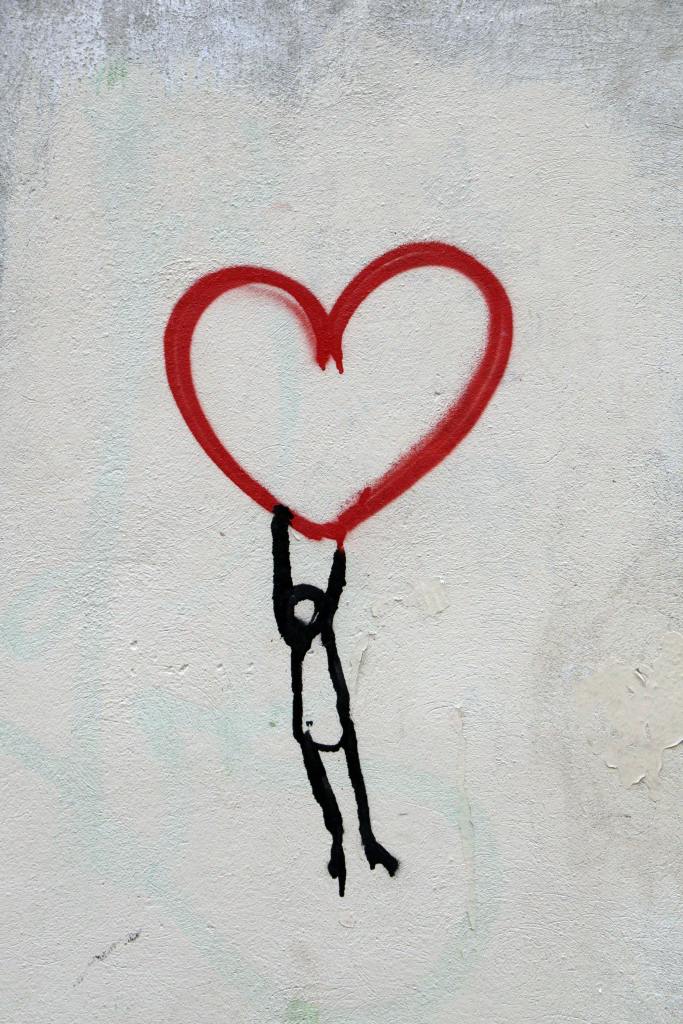
The heart has been described in the great wisdom traditions as an organ of spiritual perception. It has even been described as our second brain, having essentially its own neural network. But most of the time it seems my heart gets no chance to do any perceiving whatsoever, because my head has greedily gobbled up all available material. Oftentimes it seems like my real and desperate need is for others to intervene and help do the perceiving. “Listen to your heart”, they say, and it makes me want to run for the hills (powered, of course, by an unwittingly co-opted and long-suffering heart). And I haven’t even gotten to my relationship with the third “brain” (or first, depending who you ask): the gut.
The saying goes: “If you don’t ask, you don’t get”. To which my “gut” (i.e. head) instinct responds, “No problem. Why would I want to get anything, when I can be safe up here instead?”
Maybe my motivation to ask shouldn’t be about getting at all, but rather about practising using my heart. It should be about disproving my motivation to stay silent, and letting others know that the game’s up. Maybe I should practise asking for crazy, stupid, unreasonable, scary, childish things, just for the hell of it – and, more importantly, to show faith in my relationships. Perhaps my motivation to ask could be to engage in a practice of surrender; to engage in asking as a ritual of healing and connection.
Vulnerability only works because of reciprocity. When we put down our weapons and take off our armour, we invite others to do the same. When I put my head down, perhaps I invite others to do the same, and invite the heart back in. And when we give our hearts, we invite others to do the same.
 All & None of the Above