

What is authenticity? What does it mean to be our true selves? What does it mean to “show up”, and how are these two things different? Does authenticity mean bringing all of ourselves to every moment?
Authenticity in essence is about fidelity and integrity. When it comes to products, we want the original, true version; with people, we want honesty, realness and “what you see is what you get”. But when we consider the value of being our authentic selves, and of having others be their authentic selves also, there’s a certain hidden assumption that the selves we are showing are consistent and stable. After all, how can you be true to something that changes all the time?
Throughout our lives, and at least in individualistic cultures, we are trained to define ourselves and our lives around our unique identities. Personality is assumed to be relatively fixed over a lifetime. But there is plenty to suggest that we are nothing like beings cast in stone.
The self in context
It doesn’t take a behavioural scientist to observe that we all act differently under different circumstances. Each time you step into your office, or close your laptop and step into the lounge, you shift personas. You are different when you have had a good night’s sleep compared to when you have had an all-nighter and not enough coffee. Both the roles we play and the states we are in affect how we behave, how we make decisions and how we are with others – often much more significantly than we’d like to acknowledge.
Judges have been known to make more lenient decisions when they’ve just had a lunch break (I’ve also heard it suggested that researchers found a link between leniency and chair cushions). Neuroscientist Dr Tara Swart points to other research in which managers made less biased decisions when they’d had regular (i.e. full-sugar) Coke rather than the diet version (see here). Hangriness-related biases aside, there is also the famous 1970s “Good Samaritan” study, which involved seminary students who were prompted to help a man in need (he was a study accomplice, of course, unbeknownst to the subjects) while on their way to a different building in between tasks. Those who were told they were running late were less likely to help out than those who were told they had time to spare, despite their religious and ethical persuasions – and, quite crucially, the fact that the task they were hurrying to complete was to give a talk on The Good Samaritan.
The point is that behaviour is considerably swayed by situational variables, even when you take people’s beliefs, personality and norms into account. The self, in short, is contextual; rather than being fixed, our personalities are in fact plastic. And what’s interesting is that while we may think we want people to see us for who we really are, we also want people to understand where we are at.
How often have you done something that seemed unlike you, something uncharacteristic or even rash, because you were rushed, exhausted or otherwise having a bad day? In these instances, in the back of your mind, did you not wish others understood that backstory before judging you on that single snapshot of your behaviour? It has been said that we attribute others’ behaviour to their character much more readily than to their circumstances, but we afford ourselves much more “temporal leniency”.
The self in conversation
When we want people to be authentic, the context we usually have in mind is that of interpersonal interaction: being authentic in relation to others. So what does an authentic exchange look like?
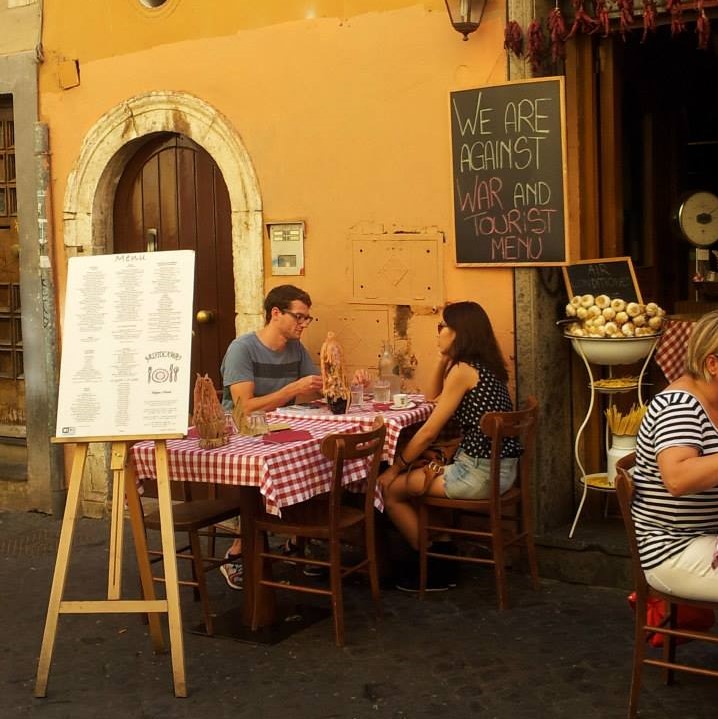
If you type the word “authentic” into a stock image search, what you get is essentially “tourism”, or perhaps more generously “traditional culture”: pictures of ancient rustic tavernas, Buddha statues, women with head scarves and painted faces, and the sorts of images whose alt-text reads “man in exotic straw hat chilling on terrace” or “ethnic workers preparing food in street”. It’s a lovely reflection of how the dominant (Western) culture is seen as the default and therefore becomes almost invisible (what is “authentic”, original Western culture anyway? Do we even have “culture”?), and hence that we have to go elsewhere to find any.
There’s also the implication that when we want an “authentic” cultural experience, people have to display their culture to us in its original form, which involves almost simultaneously pretending we aren’t there. We want them to show us who they really are: their original traditions, not some tourist adaptation – forgetting, of course, that we are tourists.
Is the implication that being authentic means being who you are, as if nobody is watching? What about the viewer – are we “authentic” in being present to observe, however passive we may feel we are being? Do we in effect disappear, exempted from the duties of authenticity altogether, and forgetting our role as active participant in a conversation?
The late writer Ursula K. le Guin, in a piece titled “Telling is Listening” within her book The Wave in the Mind (see this excellent article on it), pointed out how we typically think of a conversation as a transactional exchange between two people. Person A transmits information to Person B, and vice versa; the information travels, separate and intact, in one of two directions only (A to B, or B to A). Le Guin invites us to question the inherent assumption that A and B, as well as their respective messages, remain unchanged by the exchange. Think back to the tourism example: much as we can’t assume that our presence doesn’t affect the way others present their culture to us (i.e. the message is adapted), how can we assume that we, and also they, aren’t also affected by the encounter?
What le Guin is referring to here is known as intersubjectivity: meaning is co-created, and what emerges is not only a message that is greater than the sum of its parts, but two people transformed. The implication is that we are all selves not only in context, but continuously evolving through our communications with one another. From this perspective, perhaps, you are as many versions of “authentic” as you have relationships.
What even are you?
If, as suggested above, we’re all transient and practically semi-permeable, what is at the core of who we are? In a talk and demonstration I viewed recently on Aikido – a completely new and fascinating topic to me, as I have no experience with martial arts – what stood out for me were the philosophical aspects of the discipline. At your core, the sensei said, and what should drive your progress, what is most important is not your personality but your values. Values, it should be emphasised, are themselves not static and stable; neither are they a fixed destination or goal. You don’t ever get to a point in your life where you say: “I have now unlocked Integrity: Mission accomplished.” They are a work in progress, a direction, a driving force.
Incidentally, values orientation is also an integral part of Acceptance and Commitment Therapy (ACT), whose other main tenet is the idea that thinking and the observing self are two separate processes. Thoughts are transient and insubstantial and, while they are a part of us, they do not define us; once you have recognised this and managed to “defuse” from cognition, what remains as your inner compass are your (evolving) values.
Who are you allowed to be?
While the self is busy evolving constantly, I’m sure we would all agree that we should at least try to engage authentically on a day to day basis. But when it comes to showing up as your true self with others, there’s an important hidden variable: safety.
What is it that makes it safe for you to be yourself? How much of that is visible to you? How much of that is under your control? As humans, whether consciously or unconsciously we are always aware of the risks we take by being authentic. And what do we associate with anything that presents a risk to us? Vulnerability. Simply put, being authentic is being vulnerable.
In a talk I attended recently on Authentic Relating, the speaker emphasised that in our interactions we are constantly running a trade-off between the two polarities of authenticity and belonging. And, as social animals who are keenly attuned to the threat of rejection, we will almost always choose belonging.
On the one hand, it is difficult for all of us to open up and reveal deeper aspects of our true selves. But it’s important to recognise that for some people, just being who they are is a risk in their context. This is determined by many things like ideology, race, class, status and privilege – things which may be all but invisible to those in power, or those who represent the standards defined by cultural norms – all of which ultimately come down to belonging. So, when we as leaders urge others to be genuine and authentic, we must be aware that the risks and the potential costs for them may be far greater than we realise. We must also, of course, ask whether we are ready to see and hear them.
A colleague recently pointed out that when we think what we want is belonging, what we’re really after is intimacy. The former causes us to show only the parts of ourselves that accord with what’s expected. It also may explain why people seek (often faceless) membership in large groups as a substitute for real relationships. The latter – intimacy – is perhaps where the gamble of authenticity truly lies. We can’t be intimate without letting down our defences, and this means showing things that maybe do not accord with what is expected – even things that expose how different we are. So it is, in effect, a gamble between authenticity and safety.
Authentic Relating co-founder Jason Digges explained that we learn to push the boundaries of safe authenticity through small “experiments” in which we progressively reveal parts of ourselves to others, and then don’t experience rejection. This is where storytelling brings its transformative power: a story is a full picture of somebody. To be willing to hear somebody’s story, we are allowing all the parts of them to become visible in the form of an integrated journey. And sharing a journey through story invites intimacy because stories, by their design, allow the listener to be a participant.
What is it that you make safe for others? What is it that you make unsafe for others, perhaps without meaning to? And what do you need to be more deliberate about making safe?
Show up or let it all hang out: Lying for your own good
Probably one of the most obvious things that comes to mind when we think of the limits of authenticity is, well, the stuff that we want to “spare” others – in particular, the feeling stuff. It is, of course, important to be discerning when deciding what parts of our private worlds we share with others, and why. Obviously, true openness would be impossible (can you imagine the noise?).
We self-censor all the time, not just about how we are feeling in the moment, but also about topics that are deemed uncomfortable, inappropriate and off-limits. The problem is of course that this is the stuff we are ashamed about – or learn that we should be ashamed about, and shame cannot bear being spoken of. By talking about certain things, we undo shame and stigma, and this can be an act of personal as well as social transformation.
But shame and social desirability aside, one might say: It’s not that I care so much what others think of me, but what about their feelings? What about holding back in order to respect others’ pain, others’ trauma even? Of course, being authentic doesn’t mean being irresponsible or hurtful, or engaging in emotional dumping. With this in mind, behaving somewhat inauthentically can seem kind and virtuous, so long as we are keeping an eye on intent and integrity.
Interestingly, though, there seems to be value in being “inauthentic” about our feelings, not just for others but for our own benefit. In Amy Cuddy’s popular 2013 TED talk, “Your Body Language Shapes Who You Are”, she discusses her research showing how adopting certain expansive postures (so-called “power posing”; for example, standing square with arms outstretched or hands on hips) not only makes you look confident but also activates hormones that make you feel more confident and powerful. The key idea was that our bodies talk not only to others, but also to ourselves.
In a sense, the body can almost contradict the brain, cutting through some of our self-sabotaging mental spinning by restoring our nervous systems to neutral. There are several other known examples of how we can, and often intuitively do, hack this mechanism – for example, when we are calm, our breathing is deep and even; and when we want to calm ourselves down, we can consciously breathe deeply (out as well as in – as a side tip, the trick to calming down is to exhale fully).
Another talk with Mark Bowden, called “The importance of being inauthentic”, explores the perhaps unwitting risks of being completely transparent with our body language, and how our unconscious non-verbal signals can sabotage our attempts to influence others. Bowden explains that certain classic cues (such as eye contact, facial expressions, and open or closed body posture) prompt the primitive parts of our brains to make snap judgments about anyone we meet in order to classify them as either a “friend” or a “foe”. This then determines which data we pay attention to – or indeed make up, if there isn’t much to go on – in order to confirm our theory about that person. He stresses that our evolutionary default is to be indifferent to one another – there are, after all, eight billion people on the planet, most of whom are outside of our tribe – and therefore, in order to get anyone to listen to us, we have to consciously choose non-verbal behaviours that make it more likely that we trigger others to place us in the “friend” category.
(An interesting thing he also mentioned was how “half-signals” are perceived subconsciously as potential threats. For example, a half-smile – one where only the mouth is involved – is interpreted by the brain as “insufficient data” and therefore we default to the “foe” category. It made me reflect on just how much of the time we are operating on half-signals and insufficient data about others these days. How often do we switch off our cameras in Zoom meetings? Is there any evidence whatsoever that you’ve worn trousers to work over the last six months?)

Photo by cottonbro from Pexels
Bowden fully acknowledges the implication that engaging effectively with others is essentially a form of acting; and hence, that being completely authentic may actually be a bad idea:
“If I was really authentic with you right now, and didn’t use the behaviours that I’ve learnt in order to become a good speaker … If I don’t use my counter-measures to the fight-and-flight system … If I was being truly authentic with you, I would not show up for this… I wake up in the morning and the last thing I want to do at an instinctual, gut level is to stand up in front of a bunch of people who I don’t know, who I have no data around because I can’t see them, and put out there [my life’s work for them] to criticise if they want to…” (Here, he shifts character and gradually begins to demonstrate the defensive body language of a person who has decided to completely disregard presenter-mode etiquette and let their expertise – and mood – speak for itself. He’s proving a point, and it works.)
In short, if we were completely authentic all the time, nobody would listen to us; more importantly, nobody would engage outside their comfort zone of indifference. Bowden’s point, as I see it, is that we perhaps need to focus not so much on what we are feeling, but what we want to feel and offer to others.
“I’m begging you to act anything else but indifferent to the people around you today… [If we were all just a little more inauthentic with one another], we might find that we are so much more than we think we are – so much more than we actually are … Because I truly believe it isn’t your innate ideas or abilities or behaviours or skills or position that define or have to define who you really are, but [that it can be] the conscious choices you make in spite of all of that.”
All of which brings me to this question:
What is the point of authenticity?
As I’ve said, we most naturally think of authenticity in the context of communication and interaction. So, the devil’s advocate in me wonders: Is it actually worth anything beyond the response of others? If not, then perhaps authenticity should be less about the truth and more about what helps us connect with people.

Of course the truth matters. And of course dishonesty, inconsistency and lack of integrity are some of the main things that cut us off from others, because they pose a “contradictory or insufficient data” threat to us and so we respond with mistrust and disconnection. So, obviously we do need to operate from a base of some stability when dealing with others so that they can trust us. But, as hinted earlier, I reckon that much of what connects us “authentically” to others are the dynamic parts of ourselves.
I can’t stand fake, as I’m sure most people can’t. On the other hand, I reflected that there are some interesting cultural nuances to this: particular types of “fake” can be acceptable, even serving in some way as a sort of code or in-language. I come from a culture that loves irony, that loves to poke fun of kitsch, and that also prizes diplomacy, for example. There are different norms and standards for what is considered OK deception and OK truth-telling, in other words.
So to be more specific, then, I can’t stand it when people show a blatant disregard for the truth. But you know what I also dislike, possibly even more? Incuriosity. In practice, I’m talking about people who show up as themselves, but don’t ask any questions about anyone or anything.
Perhaps, then, inauthenticity is not all about performance. We can often see that somebody is performing. We sometimes even want them to perform. But to me, when somebody is incurious, it means they aren’t even interested in their audience. In other words, while at a basic level inauthenticity may be about perceived threat, the real pain of inauthenticity is about being with people who are not really there.
Showing up and showing all of our true selves may be different things. Perhaps authenticity means a willingness to be seen but also paradoxically to leave much of ourselves behind – or at least, those aspects of ourselves that keep us locked in fixed perspectives – for the sake of connection. I think true authenticity, in other words, is a commitment to being there.
Blind spots and the becoming self
I would add one more caveat: we arguably cannot be truly authentic if we aren’t aware of what we’re showing others.
Back in my early workshopping days, the Johari Window was (probably still is) commonly brought up as a framework for understanding the process of developing self-insight and personal mastery. I began to find it a little worn-out, until I reflected on the Blind Spot area again in the context of this blog post. The “Blind Spot” is defined as the things that others know or see about you which you yourself don’t know or cannot see. Can we call ourselves authentic if we show people things we don’t realise are there?
On the one hand, I would say without a doubt that we have to do the work: we can’t make others do the job of figuring out what we’re all about. But on reflection, maybe the reason that pane of the Johari Window is there is to make us realise that we can’t fully see ourselves alone.
The process of Compassionate Inquiry, created by Dr Gabor Maté (see a useful interview with him here), is based on the principle that we serve as a mirror to others, helping them see what they often don’t want to see about how they have shown up to others, but also how they have shown up to themselves – and doing this tentative truth-telling with empathy and kindness. Knowing ourselves, then, is not someone else’s job; rather, it’s all of our jobs.
Drawing it all together I like to finish with a thought that inspired me recently, which is that we are not beings, we are becomings. Much as we ourselves are works in progress, that progress is taking place in relation to others and to our surroundings.
Maybe authenticity ultimately is not about showing ourselves, but about meeting others.
 All & None of the Above