

How do we attend to one another?
It has been said that the greatest gift you can offer somebody is your time. We use expressions like “He didn’t even give me the time of day”, which apparently derives from the idea of somebody ignoring you to the point of refusing to answer the simple question “What time is it?”. For the most part, what we mean by time is attention. To really give someone your time is to give them your full attention; to attend to someone is to listen to them with your full presence. But in this article, I’m not just talking about listening; I’m talking about tuning in when we’re not talking, and what happens as a result.
To attune means to be receptive to something, to adapt or acclimatise towards it, or to bring things into harmony. This article explores some of the many ways we “keep time” by attuning to others, to our environment, and to ourselves, and how this synchronicity regulates how we function as ultimately social beings.
Singing together, apart
2020 for me was the year of virtual choirs. I have been part of a real choir since 2012; then when Covid-19 hit, concerts and rehearsals were cancelled indefinitely. So we set up our own makeshift recording studios and took videos of ourselves singing along, by ourselves, to pre-recorded backing tracks and a video of our maestro, conducting all by himself.
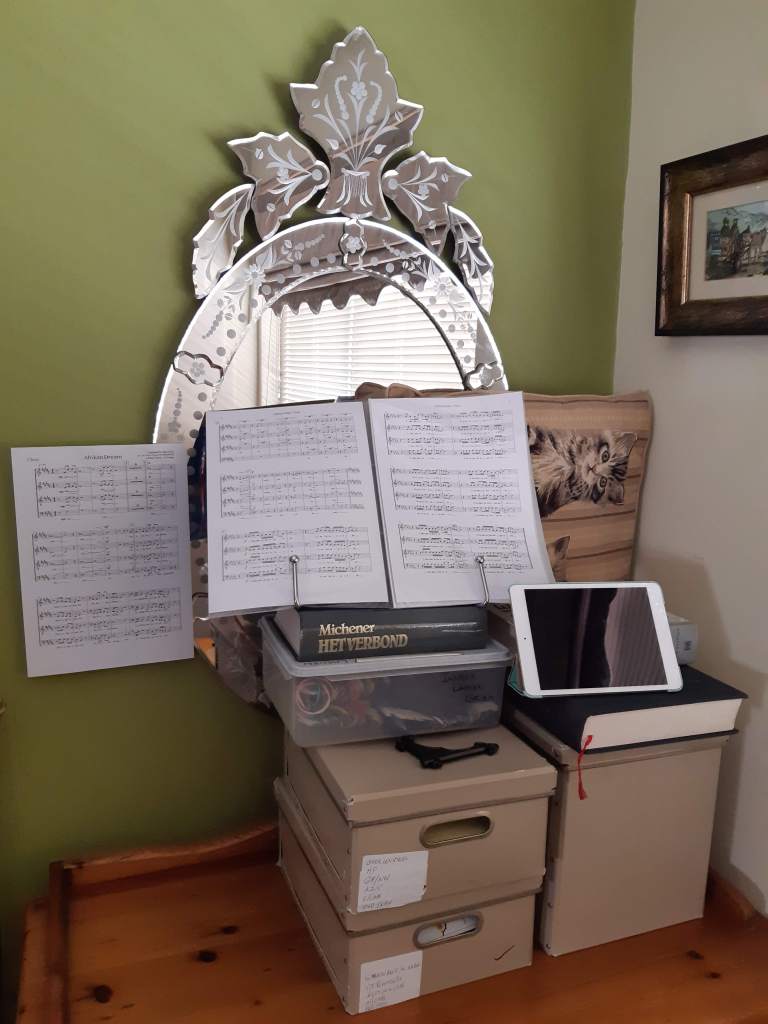
Getting your tuning right when you’re working with usually dry-as-a-bone acoustics in some study/attic/spare bedroom, along with having to see yourself while recording in selfie-mode on a cell-phone camera, is surprisingly anxiety-provoking, not to mention strangely exposing. Self-consciousness aside, there’s no doubt that technology has let us do marvellous, previously unimaginable things, like making music with people we can’t see. Combining hundreds or sometimes even thousands of vocal tracks as a substitute for a live performance is a real technological feat (an example, which I was lucky to be part of, was this video called “Sing Gently”, an international effort of over 17,500 amateur singers from 129 countries).
But even though this might make me seem at best ungrateful and at worst an absolute Luddite, I have to admit that virtual choirs make me a bit sad. The truth is, there is no substitute for singing or making music with other people, together in a room at the same time. Blending is something you do with your voice, not a computer; accoustics can’t be atomised and later pieced together like a puzzle.
There is plenty of research into what playing musical instruments does for the brain and what playing music or singing with others does for the soul, and more specifically for our bodies. Does it do all these things when we’re not in the same room as those we are performing with?
In this TED Talk, neuroscientist Alan Harvey explains how music is not only valuable for individual learning and development early in life (it boosts school kids’ motor skills, memory and possibly even Maths ability, among other benefits) but is also an effective therapy for adults recovering from a stroke or suffering from Parkinson’s and Alzheimers disease (even unlocking somatic memories in a former ballet dancer – see this video).
In groups, music making has been found to reduce sensitivity to pain and lower the stress hormone cortisol. Oxytocin levels in the blood stream increase when people sing together, but especially when they improvise. This makes so much sense to me, because oxytocin is associated with empathy, bonding and trust-building – in other words, with attuning to others, which you have to do if you are responding in the moment to your partner’s improvised rhythms and melodies.
Many of the benefits of music that we experience seem linked to its social nature, even when we aren’t playing with others. One example is that when we listen to music that we enjoy, not only are the pleasure centres of the brain activated, but also the same regions that are associated with acts of altruism. Does music make us kind, or does it make us feel good because it evokes a sense of tribal harmony? If we think of why music developed, alongside language, as a universal feature of the human species – after all, from an evolutionary perspective, music arguably has no utility – one compelling argument is the social one: music is a form of communion, if not communication. One clue in support of the latter is that even before babies learn to speak, they communicate with their mothers through “protolanguage”, which has characteristic rhythm and musicality.
Perhaps we love music so much because, on a primordial level, it reminds us of togetherness. And so singing in a virtual choir sucks just a little because we’re being reminded that we’re alone. We sing together on purpose and we miss that. Apart from the stress of singing into a cell-phone camera, there’s something about the support of others’ voices that allows mine to do things I feel it can’t do alone.

Music and the entrainment phenomenon
From the joy of making music with others, to the mechanisms of music itself: does being “in sync” happen not just at the level of the beats we play, sing or dance along to, but even in the beating of our hearts, or some other internal rhythms? In other words, beyond just being able to hold a beat, do our bodies sync to music?
Entrainment is a phenomenon in which two independent rhythmic processes, or “oscillatory systems”, interact with and adjust towards each other, eventually “locking into” a common phase or periodicity. A Dutch physicist called Christiaan Huygens is credited with discovering entrainment in the 17th Century, when he noticed that the pendulums of two clocks tended to swing in time with each other, and would return to this pattern within about half an hour when one was disturbed. As I understand it, the two clocks were mounted on a common base, allowing them to co-resonate despite each one operating independently.
Examples of entrainment include: fireflies lighting up in unison (this video suggests they can disco-dance – but heck, I want to know about the starlings); the matching of our sleep-wake cycles to the daylight hours; an audience clapping in unison (and hopefully never on 1 and 3, if you’ll forgive the musician’s joke); imitating the speech patterns of the person you’re talking to (do you “catch” accents?); the locking-in of breathing and heartbeat in high-performance swimmers (an example of what is known as self-entrainment); and the lining up of the menstrual cycles of women who live together (jokes – this one is actually contested and most likely a myth).

In most of these examples, entrainment is a two-way process (the systems influence each other). Entrainment can also happen one-way, or asymmetrically, where one process entirely follows the other’s lead, as it were, and music is a relevant example. Researchers have investigated how rhythmic processes in the human body (such as heartbeat, circulation, breathing, movement and even hormone secretion) are affected by, and might even entrain to (i.e. synchronise with), musical cues.
While we can likely all agree that music affects our mood, it’s quite another thing to scientifically demonstrate our hormones harmonising to Dr Dre. One way of measuring the entrainment of endogenous rhythms is through electroencephalograhy (or EEG technology). And as it turns out, it seems that at the very least music affects the rhythms of our brainwaves.
Researchers have previously observed how human brain waves can entrain to strobe lights to produce trance-like states and even strange bodily sensations. It was later discovered that rhythmic noises could produce the same effect (not that humanity hadn’t known about this already – ecstatic dancing has been used in shamanic and other traditions and has been known to alter consciousness since time immemorial, except that now they could see evidence on an EEG screen). (See also the Radiolab podcast “Bringing gamma back, again”, which explored research into how flashing lights and also sounds of a certain frequency were used to stimulate activity in rats’ brains, with a view towards the treatment of Alzheimer’s disease.)

This barely scratches the surface of the various forms of entrainment at play when humans encounter or make music, or even engage in any kind of dialogue. For a really enriching read, which I worked with for this post, I can suggest this paper called “In time with the music” (by Martin Clayton, Rebecca Sager and Udo Will, 2004).
Attunement
UCLA psychiatrist Dr Daniel Siegel described interpersonal attunement as the process of becoming aware of another person’s inner state, and then allowing our own inner state to shift to resonate with it. After observing the all-too-common lack of attention given by physicians to their patients’ emotional reactions to being diagnosed with a terminal illness, Siegel created a practice known as PART (Presence, Attune, Resonate, Trust) to promote more supportive doctor-patient interactions, but it also has relevance for relationships outside the clinical setting (he calls it “The Science and Art of Healing Relationships” – see more here). That so-called bedside manner is not a nice-to-have, by the way – compassion in doctors, or lack thereof, has been linked to error rates in surgery and the speed of patient recovery.
Attunement, then, is more or less about empathy, though not “emotional contagion”, as empathy has been negatively conflated with: Siegel points out that it’s not about “becoming” the person we are attuning to and taking their suffering on board, but being connected enough to sense what they are feeling. He uses the analogy of two guitar strings: the higher pitched string doesn’t become the lower pitched string, but resonates with it.
(Fun fact, which I think is rather beautiful: Certain guitars, including the sitar, as well as the hardanger fiddle, employ a phenomenon called sympathetic resonance. They have additional strings – called sympathetic strings – that are not played directly, but rather vibrate in response to tones played on the main strings when their frequencies or overtones overlap. Listen to the bewitching sound in this video of a viola d’amore.)

Still, because resonating with another person requires us to adjust our own internal state to mirror another’s, attunement might be seen as a form of reactivity, which in the field of mindfulness is one of the states that one is specifically taught to guard against. And yet, being reactive is pretty much what allows human beings to develop and thrive (as we’ll see later) as well as to stay sane.
Co-regulation: Keeping ourselves and one another tuned up (and chilled out)
In the fields of well-being and mindfulness and now well into the mainstream, there has been rising interest in the importance of self-care and self-regulation. I’ve even recently heard it referred to as the fourth “R” that should be taught in schools (Reading, ‘Riting, ‘Rrithmetic and now (self-) Regulation), and I wholeheartedly agree.
In my mind, self-regulation is what we used to call “stress management”, before we realised that stress doesn’t happen on the side, confined to the homes employees go to to quietly collapse and hopefully recover, and that the self oscillates through many states on an ever-fluctuating continuum, alongside life, which goes on. Self-care is important, but if we frame it only in terms of our quarterly date with the massage therapist, we’re missing the point, which is simply that we need to manage ourselves better on a daily basis.
I understand self-regulation as the process of keeping all of our internal operating systems (physiological, emotional, psycho-spiritual) within a reasonable range of activation and recovery, so that we can deal with the ongoing demands of our environment. Generally, self-regulation is associated with keeping our autonomic nervous system in check – that is, managing stress, and blowing off steam instead of blowing up, burning out and breaking down. When our nervous system is in a healthy state of regulation, we are able to operate from a stable platform that allows us to respond appropriately to whatever life sends our way. Our immune system is tuned up, our heart rate and breathing are normalised, and all of us basically comes online. We’re healthier; we’re able to perform and solve problems better, accessing our higher cognitive abilities and creativity; and we’re also more available to others.
How can we self-regulate better? Dr Stephen Porges, the founder of polyvagal theory (which I’ll come to later), highlights interoception as an essential element of self-regulation. Interoception, a sort of inner-facing sixth sense, is how we read the information provided by the numerous sensors inside our body. It is basically asking “What is my body telling me?” and then developing the sensitivity to discern and interpret these messages, and ultimately monitor and regulate our internal state more effectively. Porges says that this capacity is at the foundation of higher-order behavioural, psychological and social competencies. Body scans are good ways of developing interoception, and generally the simplest way to self-regulate throughout the day is through controlled, deep abdominal breathing.
So, self-regulation starts with being attuned to ourselves. What about “other-regulation”? Yes, we need to start with self, but what about what we offer to and what we need from others?
The idea of co-regulation is that we attune to and constantly affect one another’s states, not just verbally but at a non-verbal and somatic level (the field of research that explores how we affect one another in this way is called interpersonal neurobiology). It is apparently a feature of being a mammal (along with bonding with offspring, learning through play, and the distress calls displayed by an infant when separated from its mother). Shared cues, both verbal and non-verbal, help us sense and communicate danger, or the absence of it, and thus calm ourselves and others down.

We all intuitively know that others’ body language, energy or mere presence affect us, even if we can only describe it as “picking up a vibe”, or sensing that something is off in a room full of people. Others can reenergise us or make us feel like running for the hills without saying a word. You may even have wondered why you feel like a different person in different company. Turns out, it could have a lot to do with the state of your autonomic nervous system.
Beyond non-verbal cues, there is evidence to suggest that we are somehow attuned to each other at the chemical level (such as research highlighted by neuroscientist Dr Tara Swart in a seminar, which has linked cortisol levels in managers to those of the direct reports in their office (does it carry over Zoom, I wonder?). While you might care little what people think of you, as a manager it seems you should care about how you make people feel.
“Super-coregulators” is a term I’ve heard used to describe those people who make you spontaneously relax in their company, whose presence seems to welcome and make space for others. What do super-coregulators do that makes others feel good? It comes down to the simple things we already know – tone of voice, facial expressions, eye contact, etc. Critically, we have to physically see people to coregulate, and so this is something that has to be done more purposefully in the low-touch, work-from-home age.
In sum, we can play a valuable role in managing our family’s/team’s/tribe’s stress levels and wellbeing.
Chicken, egg, or coop?
You might think that in order to be an effective coregulator, we must first get the self-regulating part right; in other words, that self-regulation must come first. Naturally, the two are linked. After all, whether or not we’re taking care of ourselves effectively can determine our mood and our ability to engage effectively with others.
More interestingly, self-regulation can affect how we perceive others, which sets the scene for how we respond to them (I’ve heard of research suggesting that inhaling in an exaggerated way can cause people to perceive their conversation partners as more judgmental than when breathing normally, or focusing on the out-breath. (As a general rule, increased or extended exhalation has a calming effect, while increased inhalation has a more energising or activating effect.)
But here’s the most interesting insight for me: we can’t self-regulate effectively without co-regulating. Or put differently, we can’t self-regulate alone. In the following sections I’ll explain this perspective.
The vagus nerve and our FFF-ing Sympathetic response: We’ve been sold short
Remember Stephen Porges’ polyvagal theory? Here is an attempt to unpack it (mainly based on insights gained from webinars, but here is a scientific paper for more detail on the subject).
Everyone knows about the fight-or-flight response: we learned it in the grade school biology classroom (you may also have added the term “amygdala hijack” to your vocabulary in management training). If you’re lucky, someone may also have taught you about the third F (freeze, also known as shut-down). But nobody ever taught me that this is not the full picture of how mammals are wired to cope with threatening and stressful situations. It seems it’s not even the true story.
To tell the story, let me first introduce the vagus nerve. It’s the longest nerve in the human body, running the length of our spines and connecting our visceral organs with our brains. Importantly, it has two branches: the older (evolutionarily speaking) branch that we share with all vertebrates (referred to as the dorsal vagal system), and a newer branch, the ventral vagal system, which is characteristic of mammals, including us humans. The older branch triggers the FFFing responses you learned about in school, which are highly effective in life-and-death situations. The newer branch, however, triggers us to seek help or support from other humans when we’re under threat or stress. It’s also called the social engagement system, and the associated behaviours are also described as the “tend and befriend” response.

The kicker? We’ve evolved to do this first, before resorting to either F-ing off or F-ing up the proverbial lion that’s attacking us. Social engagement, the impulse to connect in order to restore safety and harmony, is actually our primary survival strategy (again, unless you’re faced with a truly life-or-death threat).
I almost think we’ve been sold short, having been led to believe that we behave like reptiles under stress. Maybe that’s why we often do. I also think we’ve been taught to believe that Fight is the “best” survival response, and Fleeing or Freezing is for weaklings and losers, whereas most of our instincts don’t prioritise the fight response because it is the least likely to be effective, unless you are some sort of alpha.
As a last note on this particular topic, Polyvagal theory suggests that what we think of as temperament – for example, introversion versus extraversion – might have more to do with our autonomic state (i.e. our regulation), and therefore be much more flexible, than we realise. According to Porges, even those with Autism can down-regulate their autonomic nervous system (or ANS) and thus modify behaviours that are thought of as locked into their diagnosis.
To me, polyvagal theory goes a long way to explaining just how we’re programmed not just to pick up others’ vibes, but to actively seek out resonance with them. We are literally socially wired for our own sanity.
(For an additional perspective on the stress response and the power of social regulation, I can highly recommend this Brené Brown podcast episode with Emily and Amelia Nagoski called “Unlocking the Stress Cycle”).
Attachment theory: Where we learn self- and co-regulation
We aren’t born with the ability to self-regulate; we learn it from our caregivers, upon whom we rely so completely in our earliest years of life.

Parents and caregivers attune to their infants, who of course start out life unable to communicate their needs verbally. In its simplest form, attuning here means responding to baby’s usually well-vocalised signs of distress and discomfort and giving it what it needs, be that food, comfort or a new nappy. But attunement also plays out in richer parent-infant interactions that seem to play a crucial role in many aspects of early childhood development.
One aspect is linguistic. As mentioned, language development starts out with using “protolanguage”: more than just baby-talk, this includes jointly attending to the objects of a baby’s focus, naming things and then echoing and reinforcing their babbling attempts to copy them. This dance of joint attention, mirroring and responding is part of a process called synrhythmic regulation, and it forms the “rhythm” of connection and regulation.

There’s a well-known experiment, called the Still Face study, which shows just how strong the regulating effect of parental attention is. Originally presented in 1975 by Edward Tronick and colleagues, and apparently replicated several times and in various applications, the experiment begins with a regular, playful interaction between a baby and her mother. At some point, the experimenter tells the mom to stop giving any verbal or non-verbal feedback to the child – to almost literally freeze her face. She maintains this blank, unmoving expression for two whole endless-seeming minutes, during which her baby continues to attempt to interact with her but becomes visibly more and more unsettled (in this extremely distressed state, infants eventually lose postural control and begin crying and screeching). Eventually the baby turns her own face away with a withdrawn, hopeless expression.
In the study, moms are told to drop the frozen face after two minutes and resume interacting normally with their children, thus restoring their sense of ease. But before then, it’s agony to watch (if you want to, here it is). It might even bring tears to your eyes.
According to attachment theory, which traces its roots back to the 1960s, if a child’s parents attune to them and respond to their physical and emotional needs, they are likely to develop a sense of healthy attachment, security and confidence to explore the world independently. They learn that it’s safe to expect loved ones to be there when they need them, and with a solid foundation of co-regulation from their caregivers, they rely on their parents less and less to calm, comfort or distract them. Hence, they develop the ability to effectively self-regulate.
(More than learning to self-regulate, babies are learning how they are connected to others, how they affect others, and when and how to ask for help, which is perhaps also a way of saying that this is how we learn autonomy, agency and the basic ability to trust our feelings. From an ego perspective, it’s how we learn where we end and others begin. The psychologist in me is wondering how much ego theory would be null and void if we were the type of mammals that were born with fully functioning legs, able to up and run in minutes like a giraffe in the savannah).
On the other hand, research has suggested that children with unresponsive parents have more trouble regulating their own emotions, as well as trusting and relating to others. Indeed, one key implication of attachment theory is that the level of attachment we experienced with our parents affects our adult relationships, most relevantly with romantic partners (this resource I found contains a link to a quiz you can take to assess your own attachment style). If we were insecurely attached as infants, and hence lacked that fundamental sense of safety and stability, we may go on to become avoidant, anxious, dismissive or co-dependent with our significant others.
According to the related but somewhat more psychodynamic theory of object relations, attachment affects ego development as a whole, determining how we relate not only to significant others but to ourselves and the world as a whole. If we experienced unsatisfactory early parental attachment, we may develop various (mal)adaptive strategies to compensate with the lost messages we needed to hear in childhood to make us feel safe.
A final reason that healthy childhood attunement is so important: it affects our ability not only to feel safe within ourselves, but to accurately sense and assess risk with others. Known as neuroception, this involves reading dozens of social cues and signals, at a subconscious and somatic level. Those with a history of trauma or abuse, or with developmental disorders, struggle with this and are more likely to misinterpret signals from others whom they may incorrectly judge as being safe or threatening.
To sum up, in a certain sense we can’t grow into thriving adults unless we’re reactive to others – or at least, unless we are responsive to others; and we’re wired, if not to be reactive to, then to tune in to others’ states. As grown-ups, we like to think we’re unaffected by the states of those around us, but as we’ve already seen, it seems we don’t stop needing other people to make the world OK.
Looking outwards together – Attention, bids and daydreams
Much as we’ve learned that stress management (and sometimes even self-development) was, at least until recently, something that the average employee had to do on their own time, I also feel like we’ve somehow learned that attention (and hence co-regulation) is for small kids or couples in the first six months of dating. Again, I’m not talking about listening; I’m talking about simple presence. And presence, I think, is difficult because we’ve become used to filling it with something either goal-directed or simply more attention-grabbing.
One of my favourite quotes, by Antoine de Saint-Exupéry, has to do with love consisting not of gazing at each other but of looking outwards together in the same direction. I’ve found that looking outwards together is one of the things my husband and I do best – we hike together often, and have spent four months cycling across Europe, side by side but comfortably silent for much of the day, in our own worlds but keeping the other company.
On the other hand, when we’re not out there travelling, I sometimes find myself feeling like I’m looking outwards alone, not just with my significant other but with many others. It’s not that my partner or other loved ones are trying to exclude me. It’s rather that in unromantic day-to-day life, oftentimes there’s nothing obvious to do together. But when you have a device, there is always something to do, and you don’t have to wait for it to come up.
A familiar personal example is driving the car while my husband is on his phone – checking social media, reading stories, passing time. As much as we all need space to retreat into our caves (heaven knows I spend lots of time in there, and I don’t want anyone to join me) or simply veg out, and much as I can of course occupy myself on long drives with music or a podcast, situations like these sometimes feel lonely. It occurred to me that the reason it feels this way is perhaps because of the disparity of where we’re at and what we’re each attending to. The picture in my mind is that I’m “out here”, and he’s “in there”. I’m taking care of attending to the environment, which for him has become an outsourced chore because it holds no appeal.
What does it mean to attend to each another in the context of a healthy adult partnership? Is it too much of a stretch to say that we need more than just having others attend to our expressed wishes and respond to questions? Is there something in between staring into each other’s eyes like teenagers and keeping each other company while bowed over separate newsfeeds? Of course, I’m not saying we need to share every activity; I also realise that one activity – daydreaming – is something I seem to enjoy more than others.
Maybe the real problem is not that having our needs met isn’t enough, but rather that our real needs are so hard to express verbally. Some (most) of what we need is not a favour or a request fulfilled, but simple presence. That’s why we need attunement.

The Gottman Institute, known for its research-based couples and family therapy, uses the concept of “bids” to describe and diagnose relationship dynamics. In close relationships, bids can be understood as attempts for connection, attention, affirmation, affection etc. Crucially, they don’t always sound like direct requests; they often don’t even come in question format. A bid might sound like: “I’m so tired, could you help with supper?”, or alternatively: “Haha, what a stupid road sign!” or even “I can’t get over the sunset colours on those hills.” In relationships, as in life, there is almost always subtext to any message, and so the skill here is to pay attention to the clues in your partner’s utterances in order to better recognise and respond to their bids (implicit here is that there is usually way more bidding going on than we realise).
According to the Institute, couples who respond to, or “turn toward”, each other’s bids, are more likely to stay together than those who miss or “turn away” from, or against, them (six years into their marriages, couples who were still together turned towards 83% of the time, compared to 33% among couples who split). Crucially, missing or ignoring a bid is worse than rejecting it, because the latter at least maintains some kind of engagement and keeps a window of opportunity open for repair. “Stonewalling” – or the final of what the Institute calls the “Four Horsemen of the Apocalypse” for marriages – is described as the habit partners resort to after several experiences of being turned away from. Along with the first three “horsemen” – criticism, defensiveness and contempt – these communication patterns can apparently predict divorce with up to 90% accuracy.
What does “turning toward” look like? It could take the form of engagement, agreement or simple acknowledgement; listening, reflecting a feeling and/or prompting your partner to tell you more; it could be non-verbal affirmation or simply an interested gaze. Anything that sends the messages: I see you, I hear you, I accept you, I’m here for you. The success of a relationship, they maintain, depends on these micro-moments of acknowledgement and reinforcement (here’s an article by the Gottman Institute for more on the topic, and an explainer video on the Four Horseman that offers some tips for avoiding an apocalyptic marriage).
Having to have your bid radar finely tuned at all times might sound like a lot of pressure to anybody with a day job and more than one dependant, or to those sold on the romantic notion of being comfortable in silence with each other, or to those who simply break out in hives at the thought of not being allowed their own space. But then, having a partner who is effectively attuned to your bids should surely recognise your need for silence, or space, or spacing out, after some fumbling and give-and-take?
One of the three criteria of co-regulation, according to the Wikipedia page on the subject, is allostasis, defined as a highly efficient state in which the mere presence of one’s significant other is enough to reduce emotional and physiological distress, but moreover in which partners’ needs are not just met but anticipated ahead of time. I’ve written previously about the chronic hassle of having a partner who isn’t psychic and cannot magically divine what I need without my having to say a single word. Maybe I haven’t let go of the fantasy; or maybe I’m still snagged by my sense that our opportunities to attune to others and to appreciate their simple presence is being rapidly undermined by something that poses as the ultimate co-regulation substitute: social media and technology.
Machines of loving grace – How are technology and social media tuning us?
“I like to think …
Of a cybernetic ecology
Where we are free of our labours
And joined back to nature
Returned to our mammal brothers and sisters
And all watched over by machines of loving grace.
From the poem by Richard Brautigan, All Watched Over by Machines of Loving Grace (1967)
Co-regulation tells us that our bodies want to trust, share and connect. Embodiment is more than just about ourselves in our own bodies, but about us becoming “available” to others. But how has technology affected all this? Consider Zoom meeting dynamics, particularly when we switch off our cameras – reciprocity is slowed down or violated, and the absence of visual cues essentially tells our subconscious brains that our colleagues don’t exist.
Even more important, I think, is social media. From a polyvagal perspective, evaluative situations are always perceived by the (subconscious) brain as threatening (even in medical settings: being examined is essentially like being punished for who we are). Now, thanks to the easy currency of likes and unlimited virtual networks, people think they are getting loving, affirming attention online, so much so that we may go there first before looking at our loved ones. In reality, social media is an evaluative environment, with limited accountability AND without offering us the ability to truly co-regulate by physically seeing the people we interact with.

Ironically, social media at the same time gives the illusion of closeness – on a webinar, Stephen Porges told the story of a lady who came up to him in an auditorium and said: “You didn’t say hello to me”. “Have we met?”, he asked, somewhat taken aback. They hadn’t, but she had watched him on YouTube, and as a result, he felt personally known to her.
Social media also gives us the illusion of control. We choose what we like and click and respond to, giving us the perception of having a wide-open, omniscient window on the world, judiciously spreading our attention far and wide, choosing where to place it, momentarily – or even not at all, as the case may be. Most interesting to me has been the apparent phenomenon of “ambient TV”. The idea is that there are shows that are designed specifically to be background noise (such as Emily in Paris – The New Yorker’s ideas, not mine). “Ambient” shows, in other words, are shows you can have on while you scroll (I discovered that ambient TV was a thing while scrolling through Instagram, probably while another show was on in the background, and thereby effectively recategorizing it as de facto ambient.)
Is this some perverse training for parents who need to somehow learn to filter out their small children’s high-volume horseplay? Or, somewhat more seriously, is there some connection between this and other fixes some people use to unwind, and hence self-regulate, which offer a predictable, soothing, rhythmic bassline, such as ASMR videos (guilty…)? Is it like a kind of stimming for neurotypicals?
Sidebars aside, I believe mainstream social media is addictive because it “up-regulates” us. It serves as a substitute for warm bodies and slow, rich, increasingly hard-won, complex but simple human attention. Can social media offer us presence? Can social media be non-reactive and non-judgmental? Humans struggle enough with that and then we invented Facebook. Social media is making us feel co-regulated and attuned to, but… well, just watch The Social Dilemma.
Getting in sync with ourselves: The heart
Who’s really in charge here?

The human body is a complex combination of systems. So, when it comes to getting ourselves aligned, with “pulling ourselves towards ourselves”, who’s the central commander that every other system in the body has to follow? We tend to think our control centre is the one up top: the brain. However, some researchers propose that we have three brains: the familiar one, plus the heart and the gut, which each have their own neural network.
The heart apparently has an electromagnetic field that is at least five times larger than the one emitted by the brain. And when things get out of sync with its electrical circuitry, all hell can break loose. Ventricular tachycardia (VT) is a case of the heart’s electrical signals misfiring, and the upper and lower chambers of the heart essentially getting out of time with each other as a result. When this happens, the pulse shoots up to a regular, racing rhythm (a resting pulse of over 100 beats per minute counts as VT, but I read a story in which the sufferer’s heart rate registered at 240 – he was playing football at the time), while blood pressure plummets. VT incidents, as it turns out, are not all that uncommon and they usually pass, but other cases can lead to ventricular fibrillation, which is where the heart ventricles quiver instead of pumping properly, or cardiac arrest.
On a more positive note, research has progressed into the connections between the heart and overall health and wellbeing. Central to this is the discovery that the heart sends signals to the brain as much as (if not more so than) vice versa, and the insight that the heart can therefore regulate the rest of our systems, rather than just the other way around.
According to an organisation called HeartMath, our hearts play a chief role in self-regulation for optimal health. They sell a product called Inner Balance, which appears to combine a heart-rate sensor with a mobile app to help users monitor and regulate their heart rhythms, along with 3-5 minutes of their recommended practices per day. Their method aims to achieve a state of neurological coherence, which apparently optimises our bodily functions and keeps us energised, clear-headed and resilient. In general terms, we achieve coherence when we “synchronise heart, mind and body”; technically, they are referring to coherence of Heart Rate Variability (HRV).
The science behind their technology is based on the connection between heart rate variability and our corresponding emotional and physiological states. When we experience a state of anxiety, fear or anger, our heart rate is usually highly irregular, which in turn indicates that the two branches of the autonomic nervous system, the Sympathetic and Parasympathetic systems, are out of sync with each other. Conversely, when we experience what they describe as regenerative or sustained positive emotions, such as contentment, appreciation or love, our HRV smoothes out and becomes regular, i.e. coherent. More importantly, the rest of our systems apparently entrain to this regular rhythm, and there is a synchronicity between heart and brain that allows us to operate at our highest cognitive functioning and even access intuition.
(Heart Rate Variability, by the way, does not appear to be a bad thing in itself. The heart wave patterns associated with both intense frustration and a state of calm may have the same overall amount of variability, but the frustration chart will look spikier and completely irregular, while the other will have smooth sine-wave squiggles. Higher variability indicates higher responsiveness and hence agility, a sort of readiness to adapt; conversely, low HRV is actually a predictor of heart problems.
On the topic of entrainment, I’ve seen other illustrations of the idea that perfect synchrony is not always best (for example, stable brain waves may indicate epilepsy); neither is it perceived as most pleasing when it comes to interpersonal entrainment. In conversations, research suggests that the more you mirror, the better you are perceived as a listener, but you can’t do it too precisely or rigidly: “moderately rhythmic social interactions” are experienced most positively. Finally, ethnomusicological researchers Keil and Feld in the 90s proposed that “groove” (that nebulous concept that basically describes when musicians “feel together”) is a function not of perfect synchrony but rather of “participatory discrepancies” – in other words, being “groovy” doesn’t come from being perfectly in time but from “appropriate degrees of being ‘out-of-time’”. I guess once again it all boils down to being responsive, rather than being a copycat.)
The idea, then, is that if we can learn to generate a coherent heart rhythm, we can in turn unlock the positive, stable and regenerative emotional states associated with it. And how do we get our hearts into that coherent rhythm? One way is through good-old-fashioned slow, sustained breathing. But the more effective way, they say, is essentially to generate those positive emotional states on purpose.
From the HeartMath website:
“Positive emotions appear to excite the system at its natural resonant frequency and thus enable coherence to emerge and to be maintained naturally, without conscious mental focus on one’s breathing rhythm.
[…] Additionally, the positive emotional focus of the HeartMath techniques confers a much wider array of benefits than those typically achieved through breathing alone. These include deeper perceptual and emotional changes, increased access to intuition and creativity, cognitive and performance improvements, and favorable changes in hormonal balance.”
HeartMath.com
Without going into detail, the techniques that HeartMath proposes appear more or less to be, well, metta. Metta is Pali (maitri in Sanskrit) for benevolence, good will or loving kindness. In Buddhism, it is one of the four immeasurables, or insurmountable or transcendent qualities. If you’ve ever learned a form of metta or loving-kindness or compassion meditation, you will be familiar with the technique of bringing to mind a person you love, and then essentially generating feelings of care and compassion towards them, wishing them to be happy and free of suffering. Similarly, the HeartMath practices combine breathing with intentionally generating feelings and attitudes of love and appreciation.
In essence, you are activating love on purpose. Buddhism has taught compassion since the very beginning; Matthieu Ricard had his brain scanned to prove that altruism works at the brainwave level; there’s enough research on the impact of gratitude and positivity on behaviour and health; and now HeartMath is further showing how generating these so-called “heart qualities” triggers the electromagnetic frequencies that bring our whole system into balance, as well as positively affecting others and, as they describe it, the global energy field.
All of which makes sense, even if just from a common-sense perspective: feeling love feels good. Feeling cynicism, suspicion and contempt for others feels horrible, even if it gives us some ego satisfaction. The problem is of course that this can all sound so simple, and also rather shoo-wah and snark-triggering because it uses terms like “heart qualities” and “raising each other’s vibes”. But what I think all of this encourages us to do, rather than say “well, duh” and miss the opportunity because it sounds so basic, is to recognise how often we may expect good feelings to just come from somewhere or someone. It’s basically saying: “In order to feel good, you need to feel good.” How often do you wake up and decide what attitude you want to bring to your day, or stop in the middle of a situation and do the same? Like everything, it only works through deliberate practice.
Remember when I said earlier that you can’t self-regulate alone? I feel this technique illustrates this: We self-regulate by thinking of others. We self-regulate through gratitude and love. It’s like the ultimate co-regulation by proxy.
I am not a neurologist or cardiologist and can’t claim to have read enough to understand the science. But even if it doesn’t check out, I don’t care. Even if these practices are not directly triggering heart waves that talk to your brain waves to get back into sync – even if it is simply about down-regulating the parasympathetic nervous system – I don’t care. If we could all sit contemplating love and appreciation instead of sitting on our goddamn phones for just ten minutes every day, we would very simply feel better, possibly stay out of trouble more, and also remember to call our mothers.
References and further resources:
On musical entrainment: “In time with the music: the concept of entrainment and its significance forethnomusicology” by Martin Clayton, Rebecca Sager and Udo Will. To appear in ESEMCounterpoint, Vol 1, 2004. Link to paper here.
On Polyvagal Theory: Most of my insights for this article were based on webinars I attended as part of the global 2020 Embodiment Conference. See also Stephen W. Porges’ paper, “The polyvagal theory: New insights into adaptive reactions of the autonomic nervous system”.
On attunement, neuroception and interoception: Why Attunement Matters on New York Enneagram (this article does take an Enneagram perspective, but offers great explanations and further references).
Emotional co-regulation in close relationships, a journal article by Emily A. Butler and Ashley K. Randall (2012 – link here)
 All & None of the Above