
In my previous post in this series, I highlighted that one of the defining features of a good story is that it takes you somewhere. Done properly, a story grabs and holds your attention; it takes you on a journey, and – whether through clear linking or signposting or through the sheer grip of the storyline – it never once loses you along the way. And if stories direct people’s attention, they also help us connect and take people with us.
This post offers another perspective on why, when we hear a story, we can’t help but lean forward and engage. In short, it’s because our brains are participants, not observers. They can’t help being part of the action, and the reason for this is linked to our social wiring. Finally, I explore the implications for presenting in a way that incorporates this key principle of storytelling: it’s about them, not you.
Representing reality: How the brain gets in on the action
When our brain hears information, it doesn’t just process it – it “represents” it. Thinking might be described as the process by which our brains represent reality and imagine possibility. In a sense, this is what “making sense” means – putting the pieces of the world together into an interior puzzle, so we can create and project new ones.
Over millennia, we’ve developed words for concrete things, which are essentially linguistic symbols that we can then work with in our heads when the thing is no longer there, and then communicate to others. Among so many other things, this helped our ancestors warn each other of potential future danger (“There was a lion at that river yesterday at sunset – maybe don’t go there this evening” is less helpful a warning if you need to point to the river and the lion in question to demonstrate).
One of the interesting upshots of the brain’s ability to recreate reality, is that it essentially treats thoughts as real; and words, since they program our thoughts, can carry similar valency. You can make yourself anxious by thinking about your upcoming performance review, or be emotionally triggered by a single word in an article because of the mental imagery it conjures up – the actual things don’t have to be there.
In his TED Talk, The Storytelling Animal, Jonathan Gottschall points out how horror movies still work on us for this very reason – despite knowing better, we still find fake things really scary. But critically, not only do our minds go there, our bodies do too: we can have virtually the same physiological reactions when observing events happening to other people as when we are actually participating in those events ourselves. Think of how you can have a visceral reaction to someone else’s pain, even if that person is an actor on a screen.
For some time, this phenomenon has been associated with “mirror neurons”, which were first identified in the macaque monkey close to thirty years ago and have since become widely researched and popularised in the field of neuroscience and beyond. Mirror neurons are a class or system of neurons that are activated not only when an individual performs a motor activity but when they observe another individual performing the same, or similar, activity.
Some interesting detail I discovered recently is that mirror neurons are activated not when we observe others performing random or repetitive movements, but when we observe them performing a sequence of behaviours, and we then infer the intentions behind the actions and/or can predict the outcome. For example, when we see someone pick up a bottle of water and unscrew the lid, we can safely predict that they will lift the bottle and take a sip of water – and parts of our brain, including the mirror neurons, create a “map” (or pattern of neural firing) that represents this pattern of intention in our heads. In other words, mirror neurons are part of predictive processes in the brains – our brains see what’s happening, anticipate what happens next, and then create a “map” of the sensory implications of the other person’s predicted behaviour – almost as if we were doing it ourselves (Dan Siegel explains it in this short video).

Photo by Jonny Gios on Unsplash
We don’t just see behaviour – we interpret it by inferring the intention beneath it. This makes plenty of sense evolutionarily, not just because it helps us work out what others are doing and anticipate what they’ll do next (helping us to avoid, for example, being attacked), but because it creates the capacity to imitate and therefore learn behaviour from our parents.
If anticipation is at the heart of good storytelling, and prediction is one function of mirror neurons, perhaps these neurons offer a clue as to the “hardware” behind our love of story. In essence, our brains love stories because they are wired to predict. Put differently, perhaps mirror neurons are behind our brains’ compulsion not only to attend to stories but to make up stories about any incoming data – or, at least, some related aspect of our neural wiring is implicated.
Interestingly, our brains don’t just naturally engage in prediction; they reward us when what we’ve predicted comes true. If listening to a story engages our puzzle-solving mode, the story itself, with its “happily ever after” conclusion, is the finished 100-piece blueprint.
Casting ourselves in

So, our brains actively participate in imagined realities and, more importantly, co-opt our bodies, or at least our neurology. Here’s another perspective: What if, perhaps specifically because stories are a social artefact, we don’t just vividly imagine stories but implicitly imagine ourselves as part of them?
The point I wonder about is whether we not only represent objects inside our heads, but also implicitly represent ourselves into imagined realities – both our own, private imagined realities, and shared ones. In other words, whether we do so consciously or unconsciously, on some level we cast ourselves into stories.
Either it’s obvious, or I’m going out on an evolutionary limb here, but surely the reason we have mirror neurons in the first place is because we’re social animals. An obvious implication of mirror neurons is the capacity for empathy, and if learning and predicting others’ behaviour is a survival advantage, then surely putting oneself in others’ shoes is too. We are more likely to help members of our tribe in distress if seeing their suffering puts us in distress; if we feel what that person is feeling, not just intellectually but subjectively. It’s as if our brain is saying: “I know you can imagine or even remember being there, but just to make sure you do something about it, I’m going to make it feel like you actually are there.”
Relatable: Whose story is it anyway?
When we are presented with a message, the question we implicitly ask ourselves is: “Why should I listen to this?” Whether we are scanning news headlines or hearing a colleague presenting at a conference or team meeting, we decide within probably the first thirty seconds whether we are going to pay attention.

Photo by Andrea Piacquadio from Pexels
When it comes to “hooking” the listener in with a promise of relevance, there is an artful balance between familiarity and curiosity. On the one hand, people like to be told what they want to hear, or at least to be told what they can expect to hear (which is why we love agendas, even though they do enable “audience check-out”), and they also automatically try to connect what they’re hearing with what they already know. On the other hand, if we need to persuade people to change their thinking or behaviour, we need to give them new information or ideas, so inspiring curiosity about what’s possible is the key. Hence, the listener wants to relate as well as be intrigued.
Perhaps the magic of a personal story could be that it bridges the new and the familiar. Let’s take the example of a guest speaker at a presentation. They may be completely new to the audience, might come from a completely different background to them, and may not even appear to have anything in common with them; but a story can be that nudge that takes the audience from judging a stranger to wanting to understand them. Because storytelling in itself is something that all human cultures share, it may be the only thing needed to make us think implicitly: “Ah, they are like me”. In other words, a story by itself is relatable.
It’s therefore unsurprising that a classic way to open a presentation is to tell the audience a story about yourself. The problem, however, is that this is where we might stop. We think we’ve ticked the “relatable” box and can now get on with our main content. But while a personal story does catch the audience’s attention, they need something to keep it going once the intro is done. And in deciding whether to keep listening, they quickly move from “Who are you?” to “Who is this really about?”
Every story has role players; key among them, in story terms, is the protagonist or hero. In her talk, The Hidden Structure of Great Talks, Nancy Duarte highlights the fact that, perhaps contrary to our notions about ourselves as presenters, the hero of a presentation is not us – it’s the audience. So, the answer to that last question in the previous paragraph had better be the people sitting in the stalls, not the one standing up on stage.
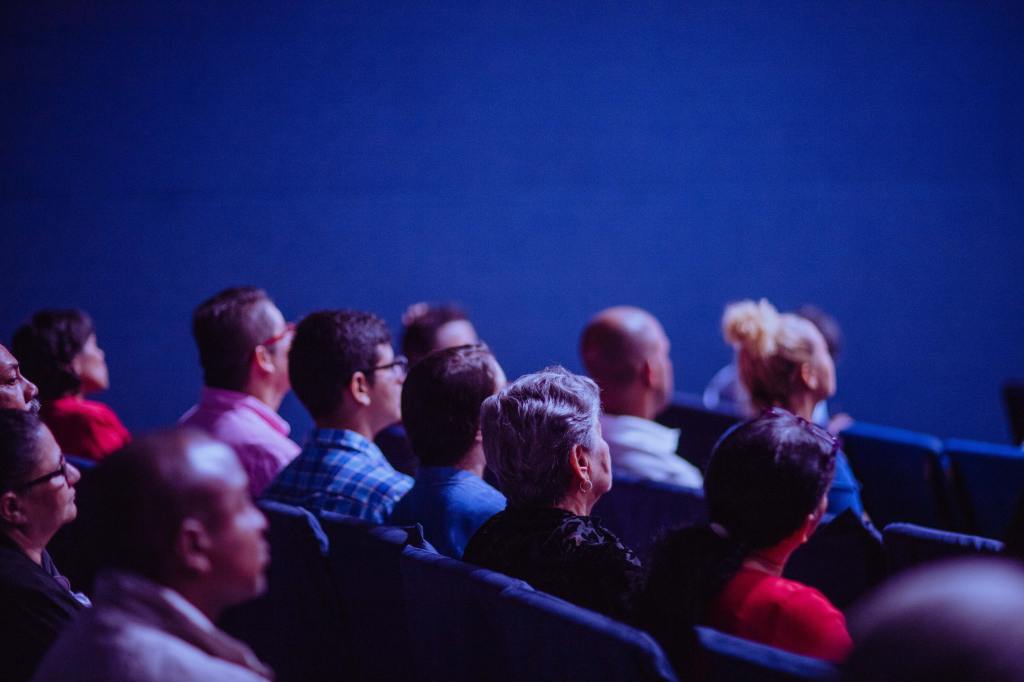
Photo by Luis Quintero from Pexels
You may think: “But the purpose of my message is to tell them about my product”, or “This is about the company vision and I need them to understand my motivation as a trustworthy leader” or “What’s the point of me telling them about them? They already know themselves – I need them to learn something they know nothing about”. This gets to the difference between the purpose of your message and what you actually want to achieve, which is the difference between “What do I want to tell them?” and “What do I want my audience to think, feel, and do afterwards?”
Of course, you can include a personal story with the objective of getting the audience to relate and listen to you. But if your communication is not ultimately about the audience, you may as well be talking to the mirror.
Apart from including your own story, or making your message explicitly about the audience, a message can become “about them” simply by taking on story form. Here’s a personal example of where I noticed the mechanisms of story at play on a more subtle level, and how it affected me as a listener (hint: remember how I said that great stories take you somewhere?).
Listening journeys: Podcasts as story experiences
Over the last year, with ample time on my hands and, quite recently, armed with a set of Bluetooth headphones that have revolutionised my experience of household chores, I have become a podcast addict. Being somewhat of a research junkie as well, I recently explored podcasts from various universities. I tried out two of them and was able to understand pretty quickly why the one grabbed me and the other fell flat.
The one, which I’ll call Podcast A, was a series of literary essays – literally, academics reading academic pieces about their field of specialisation. Each episode was about 15 minutes long, with a brief introduction by the podcast host, followed by the featured guest speaking for the bulk of it. Because it wasn’t in interview format, there were no breaks for music, questions or commentary by the host. Because these are written pieces by researchers within a tertiary institution, the words and sentences tend to be long and dense. Basically, this podcast didn’t strike me as being aimed at a broad audience (though, at the very least, they can’t be accused of false advertising).
The other one (“Podcast B”), though I only listened to the introduction episode, was a complete contrast. It included music, incidental background noise (they used ambient noise from different locations, such as a public garden, traffic-filled streets, and people noise from a mall or gallery) and various interviews, mixed with commentary by the host. Because this was the intro episode, they also included a series of quick “teaser” soundbites from interviewees featured in future episodes.
Soundscapes are a vital aspect of audio media, of course, and it’s easy to take for granted how important they are when you have gotten used to listening to podcasts with excellent production value (Radiolab, probably my favourite, being a case in point). Soundscapes are engineered to set a scene, to represent a setting that can’t be seen and so need to be conjured up inside the listener’s head – in other words, they turn text into a journey.

And then, because they form the background to the story, soundscapes make themselves disappear. You notice them when they are missing, which was the case with the other podcast. In fact, what was even more noticeable than the absence of an engineered soundscape was the presence of an unintentional one – I heard background traffic and bird noise (disclaimer: I have really good headphones). To be fair, production budgets are undoubtedly tight, particularly at tertiary institutions, and not many people can physically get to a recording studio these days.
But good editing isn’t just about production value; it’s about creating shape and structure. In my last post, I highlighted that good stories go somewhere, and this is what the second podcast did: it moved. It used a variety of elements, including soundscapes, to transport the listener from one scene to another, with commentary and signposting in between. The first podcast, on the other hand, was completely flat: each one – at least the ones I listened to – was an academic paper being read out.
Interestingly, there was undoubtedly good structure within each of those papers, and they may even have had elements of story within them, but perhaps because of the overall presentation of the episode, it lacked a narrative feel. Because it didn’t have multiple elements threaded together, it had nowhere to go. More importantly, because the meta-structure failed to take the listener on a journey, the story became about the speaker, not the audience.
Unequal terms: The experience of being read to
I then had the idea that the moment the audience realises they are being read to, the story is over – but only in certain contexts. When we’re being read to from a story book, it’s OK – but that’s because story books are an explicit part of a storytelling experience. As children, we lay in bed with our parents, who held a book open in front of both of us while they read aloud. Or in the case of an audiobook, we know this is like a pseudo book reading – we can’t see a book, but we know it’s there, in a manner of speaking, and we also know the narrator is a performer (notably, they’re called performers, not readers – we’re the “readers”), rather than someone trying to talk to us (or at us). Perhaps we implicitly imagine the narrator’s voice as an internal monologue, while we read an imaginary paperback (and perhaps that’s part of why it’s so important that we like the artist’s voice – they get literally inside our heads).

A speech being read, however, is different: it’s something we can’t see. It might even feel like the speaker has hidden it from us. It puts us on different terms, creating a sort of power distance: the speaker has something we don’t have. The fourth wall, as it were, has been drawn to our attention. Finally, when something is being read which we know has not been written in story form, we get frustrated because we know we can read faster than someone can speak out loud.
Which brings us back to what we expect from a podcast. It’s not that the content of Podcast A was not interesting; it’s just that it was more like an audiobook – or audio lecture – than a performance. Obviously, these are lecturers, not performance artists, and if one is not expecting performance-type podcasts, this is fine. But the contrast between the two made me realise just how many elements of editing serve to “storify” a podcast, and how much this changes the experience of a listener from passive to active.
Letting the audience onto the stage
Another device used to get the listener to situate themselves in the storyline of a podcast is the interview format. Podcast B, like Radiolab, has its guests relate their information to an interviewer. Because it has become more like a conversation than a TED talk, the listener can imagine themselves being part of it – closer, even, than the front row stalls.
Interview structure seems to have two benefits: first, it automatically breaks up the content, so there are gaps between a question and a response, and then often a rejoinder or observation from the interviewer; and second, it gives the reader a role to project themselves onto – that of the interviewer – which lowers the power distance and also engages our inquiry.
In other words, the interviewer essentially allows the audience to vicariously participate. If we can’t cast ourselves into the action, we can at least cast ourselves as close observers.
In sum
Story can feature on multiple levels. When we listen to a presentation or a TED Talk, we are often drawn in by a story told by the presenter, either about their personal journey towards taking up their topic, or to illustrate its relevance through an example that the audience can relate to. What the audience may not realise is that this is just a story within a bigger story, namely the presentation in its entirety. And if the presenter realises this, and uses elements like contextualising, good structuring and signposting, and engaging the audience through their senses, emotions, and active or vicarious participation, their message is more likely to land well.
For presenters, the most important point to take away is that we can’t just tell the audience stories about us, our content or our objectives. We have to show them that we see and hear their story, and that while we can’t presume to author the ending, the journey is about them.
 All & None of the Above