
I will start with a story about the Enneagram, but this post is not about the Enneagram. Rather, the purpose of this post is to ask questions about how we ask questions.

For those who don’t know it, and to simplify it drastically, the Enneagram is a system of nine archetypes that helps us make sense of our personality and behaviour. In a workshop I attended some time ago, I reflected on how I’d noticed that many of the female friends throughout my life seemed to be Type 8. Known as the Challenger or Protector, Type 8 is described as being dominant and controlling – very different traits from those that I tend to use to describe myself (I am a Type 6, or “Loyal Sceptic”, characterised as a seeker of security and all-round troubleshooter).
Now, strictly speaking, it would be inaccurate of me to describe Enneagram types as being in opposition to one another, because a key principle of the tool is that we each embody all nine archetypes to varying degrees. Nevertheless, it seemed to me that the characteristics I identified with the least – and often feel an aversion to in strangers – seemed to come up quite often in others close to me, and I began musing over the meaning of this apparent “opposites attract” phenomenon. Then, someone in the workshop group (an 8, notably), pointed out the appeal of Type 8 friendships, and said something that gave me pause:
“There’s no ‘because’.”
As I remember it, what she meant by this in the context of friendship was not so much that Type 8’s don’t need everything in life to be explained, but rather that they don’t need the important people in their life to explain and defend themselves. Whether this is a Type 8 thing or just something particular to my workshop participant is another question, but I was taken by it because it drew my attention to my personal relationship with “because”.
I realised that I have gone through life more or less as a chronic questioner of everything, myself included. Every thing and every action needs to have a reason, a justification, a defence. For me at least (though also, I suspect, for other Type 6s) reasoning is about seeking understanding, which in turn is ultimately about gaining some sense of security, if not certainty, in a chaotic world. Questioning, in other words, leads to confidence – or so my story told.
Now I was presented with the opposite view: What if confidence were about not needing explanations – not needing to ask why? There is surely great appeal in the assuredness of things being the way they are, just because – in other words, with no “because” needed.
One of the things that makes the Enneagram so powerful is that it helps us understand why we do the things we do (and hence why we suffer in our own particular ways), rather than just describing what we are like by listing traits (other personality instruments tend to do the latter, which invites the common complaint: “But this just puts people into boxes”). To some types, then, “just because” may be their standard operating system; others might identify as chronic questioners for other reasons. In my case, I recognised that while I might be suspicious of overconfident “just because” types as strangers, I may subconsciously seek them out as friends. Not only do they offer a repite from my own chronic doubt, but – and this is what my workshop friend was getting at – because I intuit that once I’m on their side, they will accept and defend me no matter what. All of which is obviously compelling for a type once again defined as a “Loyal Sceptic”.
But enough about typology. True to form, I began to consider not only my own relationship with questioning, but to question what questions do. Starting with the queen of all question words: WHY.

Photo by Edwin Andrade on Unsplash
Why we like “why”
“Why” is cool. “Why” is powerful.
In the domain of corporate leadership, we’re taught that your “why” is the core of your business strategy. Simon Sinek placed great stock in the power of “why” in his 8-million-view TED Talk on How Great Leaders Inspire Action – the one with the three concentric circles drawn on a flipchart. “Start with why” became the mantra. Get your customers to buy into your vision first; sell them why you do what you do and how you do it, and the “what” – your actual product – will follow.
On an individual level, we are taught that personal development, fulfilment and ultimately the path to success and happiness all start with defining our own “why”. Our purpose in life becomes our destination, or the shaping of our destiny. At the very least, we want to make meaning of whatever happens to us.
“Why” is also, of course, an essential ingredient of critical thinking and problem solving. It’s the foundation for root cause analysis. Design Thinking often incorporates a technique known as the “5 Whys” in order to drill down and interrogate our assumptions about problems. The key premise is that we can never solve anything if we don’t understand why things are the way they are.
If “why” is at the heart of reason, it also appears to be at the heart of prediction. The world being a chaotic and unpredictable place, we place a great deal of security in being able to understand it, the idea being (presumably) that if we ascertain why things are the way they are, we can better estimate what will happen next.
Finally, “why” is at the heart of curiosity, an attribute that is, by and large, beaten out of us by our education systems, and yet essential for adaptability, lifelong learning, and empathy.
In its fullest ideal, then, “why” bridges science and humanism; it not only unlocks knowledge, but opens us up to new possibilities.

Photo by Nicole Baster on Unsplash
While not disputing any of these things, I recently realised certain downsides to the “why” approach to life. On the one hand, I identify strongly as a “why” person, to the extent that my Instagram motto is “All who wonder are not lost”. On the other hand, I also identify as an overthinker, and I’ve come to recognise the effects that ceaseless questioning has not only on my own anxiety levels, but on others. So, I’ve come up with some experimental advice for those who, like me, are prone to overthinking:
Try asking “what” instead of “why”.
Let me explain (no irony lost there).
Solving problems: Say What?
One of my current work projects has involved figuring out how to teach critical and creative thinking to university students, firstly to help them become employable and future-fit graduates but also, as I like to think, to prepare them for life in general. A key component of both these thinking skills is, of course, the habit of asking questions.
You may or may not be surprised to hear that one of the main challenges seen among tertiary-educated graduates when they start working is the fear of asking questions. This suggests, somewhat ironically, that after fifteen or sixteen years of learning, people arrive in the business world unable to apply the ability to learn. There are a range of factors that affect this, some of which are contextual rather than related to competence – for example, graduates may lack the confidence to question authority, rather than the ability to find things out for themselves. But a broader problem may be that we assume that education implicitly teaches people how to question. And I think there’s an opportunity here to teach questioning not only to help people be better thinkers and problem solvers, but also to help them be more effective with themselves and with one another.
During this project, I was in a conversation with a learning provider who specialises in critical and creative skills training, and he made a few interesting points. The one that stood out was that in order to solve problems critically, the first step is to stop and ask the seemingly basic question: “What is happening here?”
There is a follow-up question (“And what does it mean?”), but there is a distinct break between these two steps. Most importantly, I noted, the question is “What is happening?” not “Why is this happening?”
What is the difference? Quite a lot, I think.
When things go wrong – which is to say, when life happens – we typically go around asking “Why is this happening?”. Often, we add “to me” at the end. As we ask, in essence, “Why is it like this?”, we may completely gloss over or forget to focus on “What is it like?”
We know that perfect objectivity is an elusive ideal. But asking “What is happening?” could help us to at least try to be more objective when solving problems, because it prompts us to define before explaining. It draws attention to the concrete: “What do I observe here? What have I heard? What are the facts?” And then also, “What are my doubts? What are my suspicions? What am I assuming?”
“What”, in essence, creates distance from the problem, as well as from our doubts, suspicions and assumptions about it. Importantly, too, it doesn’t preclude us from seeking an explanation – it just helps us step back first before launching into interrogation mode. Whereas if we jump straight to “why”, we might take all those things as implicit.
Perhaps put differently, asking “what” helps us frame a problem and itemise its various parts before attempting to solve it. Because the other key question is what we ultimately do about the problem at hand.
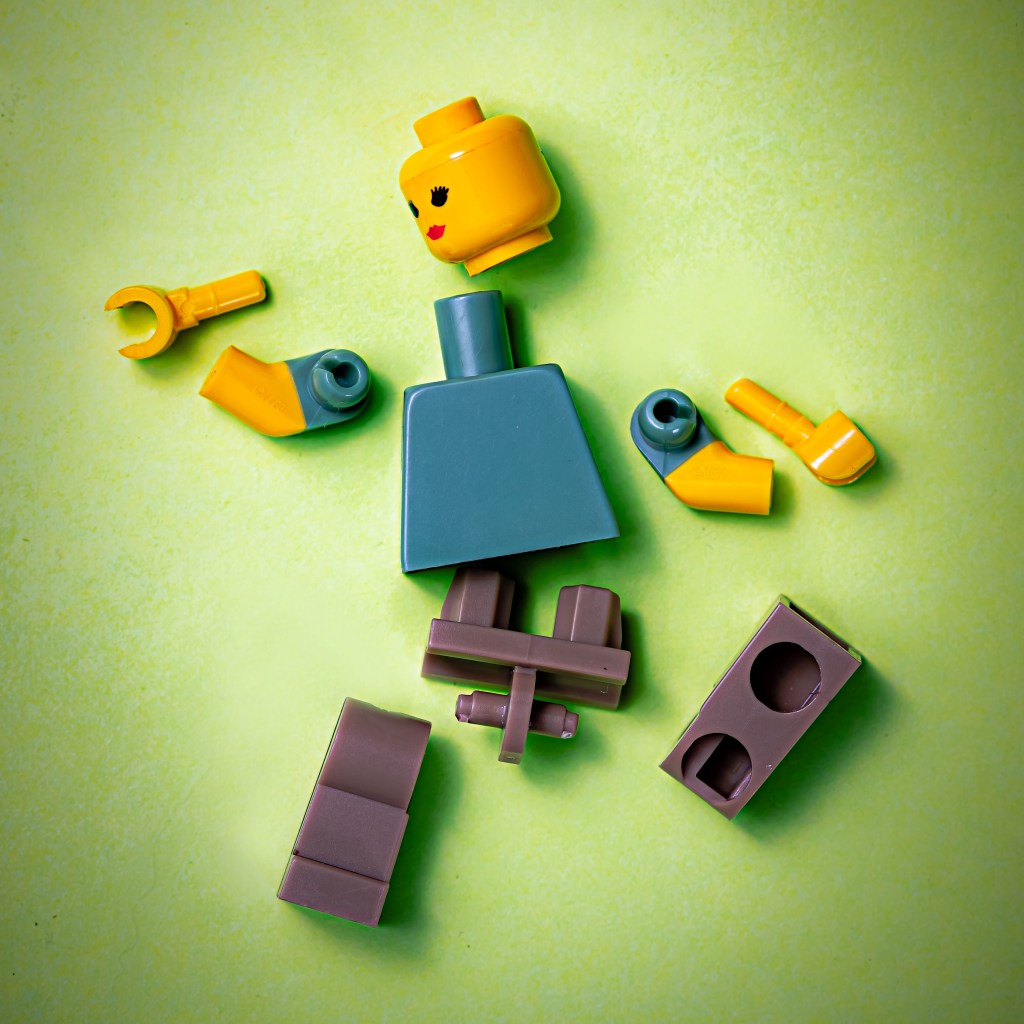
It is what it is: The anxiety of “why”
Apart from being insufficient as a problem solving approach, “why” can also get us quite wound up.
In my experience, behind the question “Why is this happening?” is often a sense of struggle and, by implication, non-acceptance. This isn’t always the case, of course – we may be seeking to understand life’s obstacles from a perfectly cool, calm and detached stance (luckily for me, I married someone who does this most of the time). Appropriately, then, I guess we could ask: “Why am I asking why?” Am I seeking to understand and fix the problem, or am I demanding an explanation because the situation is unacceptable or unbearable?
It is perhaps helpful to reflect on the difference between wanting to solve problems and being invested in a certain outcome, or in things being different. More than that, we may also be invested in there being a reason for everything in life. We might be angry that things are the way they are; we might be even more appalled by the prospect of there not being a reason for it all.
There’s a Buddhist mantra that goes: “Anything can happen at any time”, mentioned by the American Vipassana teacher Joseph Goldstein in a lesson on Sam Harris’s Waking Up. It is meant to remind us of the principles of impermanence and non-attachment. Goldstein acknowledges that, at face value, these words sound ominous, almost a portent of constant chaos. But they’re really meant to be a relief – if anything can happen, and it is in the nature of everything to change, we may as well go with the flow. My personal translation of the mantra is: “This is not a mistake” (and by “this”, I guess I ultimately mean “life”). And this, in turn, maybe points to the other implication of “Why is this happening?”, namely: “It’s not meant to be like this”.
Which takes us to the next issue with “Why-ing” our way through life, and that is when we turn it firstly on others and secondly on ourselves.

Photo by Nigel Tadyanehondo on Unsplash
Explain yourself please: The judgment of Why
In a post from the Instagram account of Hope For the Day, a mental health support and suicide prevention organisation, they list tips for how to help someone going through mental health difficulties. One of their key messages is that if you are trying to be supportive, “what” questions are better than “why” questions.
Think about it: If you were struggling with depression or even suicidal ideation, what would you rather hear? “What are you going through?” “What can I do?” “What do you need?” Or: “Why are you always so down?” or “Why don’t you try this…?”
“Why” questions, in other words, can have a judgmental tone, even if that’s not what you intended.
Now consider how we apply “why” to ourselves. Is it not the case that when our self-talk starts with “Why”, it is usually accompanied by a sense of self-judgment, or at least with a certain level of intolerance of our present state?
Why am I so angry? Why did I eat so much last night? Why can’t I stop thinking about work?
Again, I’m not saying we shouldn’t try to understand ourselves. I’m saying – and still realising for myself – that, paradoxically, asking “why” doesn’t necessarily help us get to understanding. At the very least because it skips the step of acknowledgment.

In her work on emotional agility, Susan David advises us to move from “I am angry” to “I am noticing that I am feeling angry”. To develop this further, with inspiration from compassion-based mindfulness practice, we can add “This is anger” or “This is what anger feels like”. There is power in separating ourselves from feelings, and labelling or defining is the mechanism by which we achieve this distance.
On the one hand, we might think that describing a feeling will lead to us getting stuck and over-attached to it. On the contrary, I think it achieves two objectives: on the one hand, by labelling the feeling, we’ve taken the step of acknowledgement while creating distance; then, taking the step of asking “What is this like?” makes room for appreciation and understanding; which, finally, allows us to move onto “How can I change this?” Put differently, if we see a feeling as separate from ourselves, we can see it as a process, as something impermanent. Even if we don’t achieve complete objectivity, we at least come to a sense of equanimity.
“The love of our neighbour in all its fullness simply means being able to say, ‘What are you going through?'”
Simone Weil
I said earlier that “Why” is a precursor to empathy. Here I’m seemingly contradicting this and saying that there may be more empathy in “what”. It might even help us parse the difference between empathy and compassion. To me, “why” even suggests the kind of backhanded empathy – which is in fact not empathy at all – that is invested in change, but for the listener’s or even the world’s sake (“Why can’t you be more like x?”). Or it could convey the need for an explanation, but on the listener’s terms, or once again for the listener’s benefit (“Why can’t I understand you? Why can’t you make sense to me?”). “What”, on the other hand, lends itself to understanding things on the speaker’s terms. “What are you going through?” is asking the other person to describe their reality, without asking them to make you understand.
To take it a step further, the process of compassionate inquiry can include the step of acting as a mirror to the other person, but with the intent to alleviate their suffering, not yours. “This is what you are saying” shows recognition; “Can you see what you are doing?” shows courage and an intent to help them recognise. This is compassion at its most courageous and, I would say, aspirational. The approach described here (very briefly) is inspired by the work of Dr Gabor Maté), and a critical part of it – I would say the hardest part, which is perhaps what makes it so aspirational – is to stay out of judgement.

What about me and you?
Maybe the key to not judging others for what they are (or seem to be) doing is to constantly remind ourselves to ask: “What am I doing?” Am I listening, or am I preparing what to say next? Am I empathising, or am evaluating, am I assuming? Am I seeing the other person, or am I seeing a group, a colour, a stereotype, or a role that I expect them to play? Am I listening to a loved one raising personal concerns about taking the Covid-19 vaccine, or am I playing out a narrative about anti-science and the triumph of misinformation and just waiting impatiently to apply the labels “anti-vaxxer” and “conspiracy theorist”? Am I concerned about the anxieties of a loved one, or am I resenting that they seem to keep raising my own anxiety levels? With a bit of intentionality, “What am I doing here?” could cut through that vilifying voice that says “Why are you doing this to me?” or “Why do you have to be this way??”
A final useful “what” question is: “What do I really want?” The easy answer might seem to be “To fix this”; the somewhat less noble answer might be “To be right”. A bigger and more helpful answer, though we may not see it in the moment, might be something like: “To understand what my significant other is really concerned about and to help them calm down, feel heard, or just vent”. And perhaps more genuinely: “Not to lose connection. To support them. To feel supported.” Here, we become aware of our own needs as well as others’, and then need to acknowledge our responsibility to look after our own hurts, as well as attend to what the situation needs. All of which is hard or, more hopefully put, a journey.
If we can remember to do these things in the moment – or even between the moments that are hard, noticing where we have judged others and, in turn, ourselves – and stay focused on what is happening, we might ultimately be led by what is most important. In other words, with a bit of luck, “what” might remind us ultimately of our bigger “why”.
 All & None of the Above