

In April 2022, I did a solo overnight hike in the mountains of the Western Cape in South Africa. My husband and I had planned to join my sister and a group of her friends on a camping and climbing trip over the Easter weekend. Whenever rock climbing is happening, I am usually either spectating, reading, or hiking, so it seemed the right opportunity to do some more of the latter.
Since varsity, I have had a considerable amount of overnight hiking experience, much of it shared with my husband. We both love mountains, though his appetite for spending continuous time covering distance in them certainly trumps mine. He spent much of his sabbatical traversing entire ranges such as the Pyrenees by himself. Hiking solo was an experience that he loved and was naturally enthusiastic to “share” with me – that is, by helping me get set up and then leaving me to it. The upside was great support for me. The downside was that he had FOMO.
I had done solo day hikes, but never slept solo in the wilderness overnight. At least I could do most of the things associated with overnight hiking, which fall roughly into two categories: 1) finding camp, and 2) making camp. We simplified the latter by planning for me to overnight in a cave, rather than having to carry a tent for one night. Working the stove was easy and meal planning is usually up my alley.
Regarding the former, the hardest part about navigating was finding the cave. It was slightly off-trail, but this was fine because it was clearly marked on the map. Otherwise there was a clear path for 90% of the hike, much of which we had done less than a year before. The path on Day 1 was familiar except for the side-excursion to the cave; on Day 2, I would be taking a few new sections of trail to connect with my return route, which went past a rock pool that I had visited several years before and had been wanting to swim in again. This was my plan for Easter Sunday brunch.
In fact, if I’m honest, the hardest part about navigating was simply making sure I remembered to press the right buttons on my husband’s SPOT tracker device. This little gadget is a GPS-enabled one-way communication device that sends pre-programmed notifications when you start and finish an excursion, pings your location every 15 minutes or so (so others can watch your trail of virtual breadcrumbs from their desks or armchairs), and also has SOS functionality. Two types of it, in fact: One alert goes to a group of personally-selected recipients, like next-of-kin contacts and those with mountain rescue connections; the other goes to a command centre in the United States where they can mobilise rescue services anywhere in the world.
The only trouble with the tracker is that, apart from lights that flash when a message has been sent, there’s no way to receive any feedback from it. Blue ticks, as it were, are very much not a feature. You also have to make sure it’s got good “clearance” – in other words, you have to make sure it can “see” the sky when you send your notifications out into the ether. The tracker gave me a sense of safety, as well as a curious feeling of being watched, but from a distance, and only by a chosen few (introvert’s dream?). All the more curious because at the same time, I did not particularly want to run into any other hikers. Which brings me to my main reason for doing this.
My idea was to treat this not just as an experience of being self-sufficient in the mountains, but as something of a solo mindfulness retreat. I had done a few “micro” versions of this in the past. At eighteen, as part of a 10-day youth wilderness camp, I did a short “vision quest” – we were sent in all directions from our base in the mountains, with the instruction to spend a couple of hours of quiet solo time, whether meditating, journaling, pondering life or simply napping in the shade of a boulder. In my adult years, I have done mindfulness-based weekend retreats which involved silent time between dinnertime and breakfast. I also meditate daily, and try to bring this practice along on multi-day hikes. Because formal sitting practice can be inconvenient in mountain terrain, I’ve begun exploring ways of practising more flexibly – basically, by paying more attention while walking, when pausing for a break, and also prompting myself to pause more often and look around.
So, I had plenty of experience meditating, plenty of experience hiking and camping in the wilderness, and quite a lot of experience meditating in the wilderness. Now I just wanted to bring these all together. And simply to see what it was like to be alone in nature.
The objective, if I can put it this way, was not so much to hike but to observe. Accordingly, what follows is not so much a hike report but a collection of observations or field notes, both outer and inner.
Taking stuff places

One of the beauties of hiking is that you cannot take too much stuff. The repertoire is limited by the necessity of carrying everything. Being forced to travel light, of course, has many payoffs. Packing out the exact same items of clothing every time can be a relief in a world oversupplied with choices. I also muse at the predictable comforts of cooking a simple, hot meal on a mini stove after a day of walking. Admittedly, this was not quite survival 101 – I failed the “bare minimum” test when I added toasted pine nuts to my dinner menu. I was also carrying chocolate Easter eggs.
Simplicity can be liberating. That being said, getting to this state can be, for me at least, anything but simple.
As a general observation: there is such an amazing amount of faffing to be done. In life in general, on hiking and camping trips in particular, and, more specifically, for me personally.
I have an interesting relationship with stuff as it is. I am bothered by mess, and yet I seem very good at generating it. I like to cook elaborately, so my kitchen activities usually involve an arsenal of ingredients and tools. When it comes to packing, others seem to get the “less-is-more” principle right, while my modus operandi seems closer to “more-just-in-case”.
It’s not just that I struggle to choose what to take and what to leave; I also find myself in an interesting dynamic whenever I try to multitask around little items. One hand starts a task, and the other will start another, or bring something else along for the ride. Grouping things, for example when tidying up around the house, can be efficient – that is, provided you complete each thing. In my case, the things seem to somehow compete with each other, to splinter and proliferate, and ultimately I may run out of steam to complete one or any of them.
Now, given how much time I spend going on trips where camping is involved, and therefore where choosing, sorting and packing things is business as usual, it might seem surprising that I haven’t gotten this faff thing sorted out by now. But this is the story of my life, as a packer and, as it turns out, as a writer: less is way, way more. Effort, that is.
The added complication of this particular trip was that we were first joining a group of friends for campsite-camping, and campsite-camping has different requirements to hike-camping. The former allows greater quantities of stuff to be brought, and also calls for bulky extras such as cooler boxes and crockery and furniture; the latter requires some items to be dispensed with and others shrunk. The general pattern was more-to-less; the dilemma, among others, was whether to decant items from the campsite-camping collection, or to separate them from the start. Unsurprisingly, I did a mix of the two and ended up with about seven bags of items in the car, with my hiking ingredients and cookware distributed unevenly across all of them – and other rather obvious items omitted entirely. On the one hand, I packed up almost the whole pantry of teas, spices and condiments; on the other, I neglected to bring plates.
In short, streamlining a kitchen – twice – can be agony. But let’s move on.
Putting stuff down (and a minor visitation)
I don’t know about anyone else, but whenever I put stuff down and step away from it, I get a little anxious. I attribute this mainly to being a South African. Once, I had just arrived at a train station in Switzerland and needed the bathroom, and the Swiss woman I had just met on the flight told me to just leave my backpack on a bench and go into the ladies’ room, so that I didn’t have to cram my luggage inside. Was she going to watch my stuff? Nope – she was coming in with me. This was something completely foreign to me. There was my backpack, sitting all by itself in a public place, with no defence and no explanation for itself.
(Looking back, I hadn’t thought of the existence of security cameras. This might relate somehow to South African self-reliance too.)
What’s interesting is that this vigilance persists even when there is nobody else around. It might seem illogical, but even in a situation where you are alone in the mountains and therefore several kilometres from any other human, putting stuff down and walking away from it still feels tenuous. To be fair, while the typical concern might be about one’s stuff being taken, the additional worries in this context are firstly about being without one’s stuff, and secondly about not being able to find it again.
On this hike, I left my pack several times to go on side excursions – to summit a nearby peak; to do a brief off-path reccie to check my navigation; and lastly to fill up with water at a stream below the cave, at the end of the first day. Because I wasn’t “home” yet, those first two excursions had me feeling especially attentive to my surroundings (which rock did I just lean my pack against? Remember to turn left at the cairn that looks like a rabbit. Don’t snap off a foothold and get trapped under a boulder, 127 Hours-style) and mindful of what I took along with me (waterproof jacket; cell phone, even though there’s no signal – at least they’ll have my photos; half-empty water bottle, so even if get partly immobilised I can pee in it – 127 Hours again…).
Aside from the not-unfounded worry of being separated from my gear (and the tracker), my oddest worry was simply that somebody would find my pack and want an explanation for it. Whereas it was probably more likely to be stumbled across by a troupe of baboons, and I suspect they wouldn’t care.
As it turns out, my vigilance was in some ways vindicated by my overnight experience at the cave with some unwelcome company: rodents.
I had put my trash into a ziplock bag – some sticky, blackened foil, which had contained the cold braaied sweet potato I had enjoyed, stuffed with tuna, for lunch – and placed it, carefully sealed, on the low stone wall that bordered by sleeping spot. I stepped away for a moment to the edge of the cave to brush my teeth. Mid-rinse, I paused: I heard rustling. I turned around to see the trash bag thrashing about. “Ha! Bastard!” I cried, as I darted back and snatched it up to reveal the literal tail-end of the culprit: a mouse, which had already managed to start nibbling the bag open from underneath. The thief scuttled off – not fast enough, and it wasn’t the last I saw of him that evening.
That night was a comedy of errors entitled Me versus Mouse (or Mice – I didn’t ever see more than one at a time, but there was enough going on for me to feel somewhat in the minority). At one point, I had the bright idea of removing the sticky foil from the trash bag and placing it under a rock as a sort of “decoy” – only to lie awake listening to the sounds of aluminium being shredded to pieces, and picturing having to collect several hundred tiny bits of foil shrapnel from every corner of my campsite the next morning, like an eco-unfriendly starburst. I got up and did damage control several times. At this point, I will offer you two bits of practical advice: 1) Always hang your food and rubbish – mice haven’t figured this out yet; 2) Apart from food and food remnants, mice will go for anything that came into contact with food. This includes wet sponge scourers and the soft silicon edges of a long-handled spoon.
I reflected that I had already broken whatever “silent” element of my retreat I may have been going for by shouting profanities at rodents. But then, the aim of the experience had not been to be quiet, but rather to listen for inner silence. Of a kind.
Talking to oneself versus self-talk
I don’t know if it’s possible to say “Wow” on the inside. That is, not to say it out loud.
When the full Easter moon came up that night, it was a like a blazing liquid gold fire-orb, a blinding glorious eye of Sauron piercing me open in awe. I stood there with my jaw literally hanging open and my eyes as wide as I could get them. I then cast about, almost beside myself that there was nobody around to show this to, to share this magical night-time scene. The moon was casting actual shadows.
I tried to capture it on camera (a non-starter). I wowed out loud some more. I felt compelled to sing.
Now, I use my voice a lot. Even – maybe even particularly – when there is nobody else around. And I have come to realise that the voice is an instrument not just of communication but of self-regulation.
I talk to myself and I talk myself through things – many of us do. There is assurance not just in words but in vocalisations. The soothingness of sighing. The assistance of grunting up a big awkward boulder step. The satisfaction of laughing out loud, not just when something is funny but when something is a relief or an accomplishment, like when you have successfully arrived at a cave you put effort into navigating to.
It is awful not being heard when you need to be. On the opposite end of the spectrum, there is something wonderful about not being heard when you want to make a noise with zero consequence – to be able, for example, to grumble without having to explain to your other half what’s wrong.
Hearing oneself might be a primitive form of self-validation. Before the hike, I had a conversation with my sister about the curiosity of almost doubting one’s own existence when there is nobody else around. In the absence of witnesses, there can be a strange impulse towards referencing invisible others – and perhaps we ourselves then stand in for the role of “other”. There is also a strange feeling, at least for me, of self-consciousness when there is no one watching, and I suspect that this is the product not just of the basic fear of being alone but of the inner critic taking over the witnessing role.
Self-talk, then, often tends towards the negative. This is certainly the case for me in the course of everyday life. Usually when I hike, negative self-talk may still come up, but then what usually replaces it is a stream of completely arbitrary, brain-on-standby material. I’m talking the entire dialogue from episodes of The Simpsons I watched in the nineties. Or jingles from ads. It’s as if the inner critic has finally sat down to make way for a general brain detox.
At the very least, talking to oneself and vocalising is a form of dispelling energy. A release of tension. A discharge. The use of one’s voice on the outside may be all the more helpful, perhaps, when getting to a place of having nothing on the inside but wakefulness.
Sounds and sensations
How easy it is, when it is otherwise very quiet, to be startled by one’s own body, by one’s own movements. You think you are standing perfectly still, having stopped hiking to listen to what is there beyond the crunching of shoes on a sandy path, and then you get a fright from the sound of tiny stones moving underfoot as you shift your weight ever so slightly.
Humans are noisy. When you hike solo, you realise how loud you are. And how loud the silence is.
Because we are human, we may forget that things happen independently of us. Things like weather. It is necessary, perhaps, to remind oneself that nature makes its own sounds – and that these are not orchestrated by some singular force or actor. To remind oneself that reeds rub against one another when the wind blows. That when the wind changes direction, it makes the tiny trickle of an almost-dry stream change volume, making it sound – suddenly, to the human ear – like more water is running, and making you imagine that a flash flood is coming, from under a clear blue sky, out of nowhere.
Sounds arise; thoughts and inferences and predictions and imaginings escalate. Both dissolve. With the help of listening on either side.
I did a lot of listening. And looking. And feeling – asking myself if I could still feel my body, whether moving or standing or sitting still. And reminding myself constantly to return to these things. And reminding myself that it didn’t really matter which of my senses I chose to settle on at any given point. Or that I might not be able to settle for very long at all.
Just keep listening. Listening, at least, takes you outside.
When I was lying in my sleeping bag, for a while at first I could feel and hear my own heartbeat. Outside my sleeping bag were the in-and-out sounds of running water – water from the smallest stream, thankfully close by the cave, draining from a mostly desiccated plain, which I had collected patiently in a wide-necked water bottle while reeds tried to poke my eye out – the lightest wind, the tinkle of a frog, and I think some other night-time creature (insect or bird?). My ears were pricked for evidence of further mouse-rummaging, my mind’s eye on the food bag hanging from a flake in the cave’s ceiling.
I heard, too, soft ticking, twitching, tapping sounds. Regular sounds. Were they in time with my breathing? I checked; listened; felt. It was a sort of rubbing sound, small and subtle.
Eventually I figured it must be the sound of my own body, lying on an inflated camping mattress, as it shifted and shuffled in miniscule increments down a heavy-duty plastic ground sheet, which had been laid out on top of a dry, straw-dusted, slightly down-hill-sloping cave floor.
I was listening to my own continental drift.

Nerves
A few friends commented: “That’s brave”. A few asked me: “Weren’t you afraid? Out there, by yourself?”
The best way I can describe it is: I was many shades of vigilant.
The main experience was that of alertness. Watchfulness.
It may seem funny, but I don’t think I was conscious of being far away from people. Dad asked me afterwards what distance I was from the nearest other humans (10km, or thereabouts). It’s hard to remember whether I explicitly thought about this and whether it perturbed me. I was aware of thoughts of “heading out” on Day 1 versus “heading back” on Day 2. I did feel a little lonely – or rather, that I would have loved my husband to have been there – from time to time, but not a lot.
And I had the SPOT tracker, so in fact I felt more conscious of the responsibility for people not to worry about me. I did also see one particular set of footprints all along my path, which was a source of reassurance, along with regular cairns as route markers. But the closer-to-home, more salient nervousness was, I think, a general vigilance around placing one foot in front of the other.
Day 1 began with a climb, straight out of the dirt parking lot where my husband had dropped me off. From motorised transport to a slow uphill start, I was hit by the contrast of new types of sensory bombardment: pack weight, the effort of my legs, the noisiness of my hiking poles, an escalating heart-rate thudding against the sudden silence.
The wind was cold, but it was very bright. I remember being wary of snakes. And wary of loose rocks. And consciously telling myself that every step had potential consequences.
Look carefully. Also, pause and look around.
I paused at a river spot where we had stopped to put on sunscreen back in winter the year before. Today it was mostly dry. There was a thin sheen of water filming the flat boulders, a tiny pool; I stopped, dipped my hands, took a photo. I looked back down the valley to the campsite, which was like an oasis in the mid-morning haze.
Earlier on in the climb, I had seen a group of three other hikers, heading out from the parking lot below me, and this had gotten me somewhat on edge; but they had taken another track. I saw nobody from then on until the following day. No signs of life except those familiar footprints, and cairns.
The best bits were the peaceful, white-sand stretches along the plateau, when the ground levelled out after the climb. Familiar, open, easy-flowing; surrounded by intricate, scalloped, weathered rock formations and fields of carved-out boulders, like abandoned chess-set pieces.
Rocks. Watching rocks. Rocks watching.
History watching. The erosion of time, pacing itself over millennia. Thoughtless millennia. Time to breathe out, and in, and to hold one’s breath briefly while looking around.
Time to take what time you need.
I considered that it may be easier to be careless with your footfall when you are with others, when your job – unconsciously, maybe – is to follow someone else. Again, the awareness of consequences. Every step I take is my own.
It’s a completely different kind of being in the zone.
Watching
Birds. Gentle company among the silent open-air galleries of rocks. Soft, bright touches to accentuate the stillness. I saw little swallow-like birds, flitting and bobbing up into a quiet air-buoyancy, hovering momentarily above boulder fields and swishing restios. Two starlings, their presence somehow slightly menacing (maybe it’s the orange accents in their wings?) caught my eye above the rock pool where I took my Easter breakfast swim.
The one other bird I saw was an owl. I was coming down the steep part of a kloof, which was stony-bone-dry down to the bottom, and disturbed the bird, some 10-20 metres below me in the bushes not far off the path. It took off, a heavy, motley-brown mass, wheeling down-valley in a slow, majestic arc, leaving me breath-taken.
I did not see any other wildlife, though I did hear the calls of either dassie or a bokkie or two. And I saw an airplane. Passing above the ridge opposite my cave, soundlessly.
I sat by the river and looked. And at the cave and looked.
Getting to the cave, first of all, was just so satisfying. I expressed this out loud, of course, to myself and the surrounding fynbos. I had reached my day’s goal. I had proven that I could still navigate. And I even had the tracker to prove it.
I took SPOT off the lid of my backpack, went and sat on a boulder in the 3pm sunshine, hit the All-OK button, waited for the light to flash, and set the device down on the rock to let it send its GPS messages home. I took off my shoes – one wet sock from stepping through boggy patches in the field of thick, crackly, nesty reeds I had just goose-stepped across – and enjoyed airing out my toes and sitting with my legs stretched out and my heels resting against the rock and the sun on my back.
Later I went to fill water, from the tiny stream whose welcome sound I had heard when sitting at my “all-OK” boulder. Then I meditated on a flat rock until the sun dipped and the shade and chill reached me.
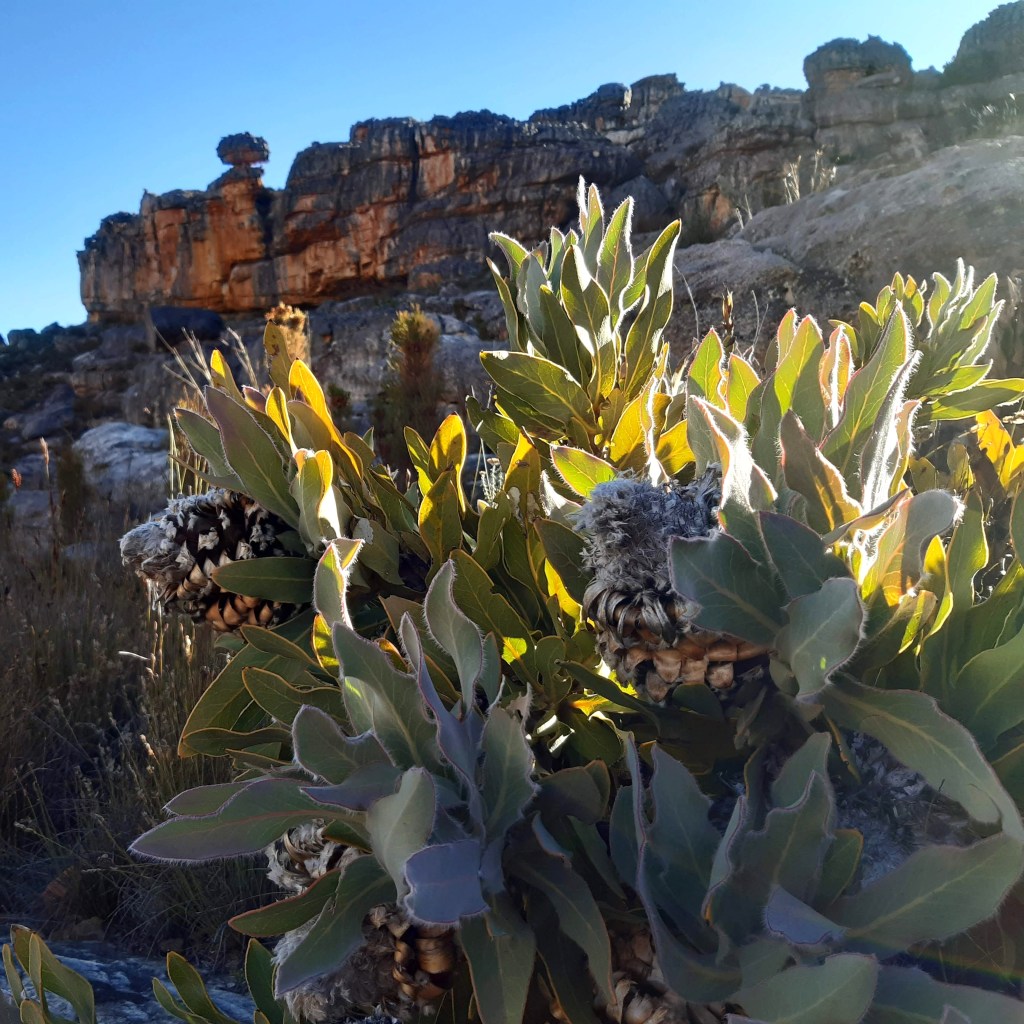
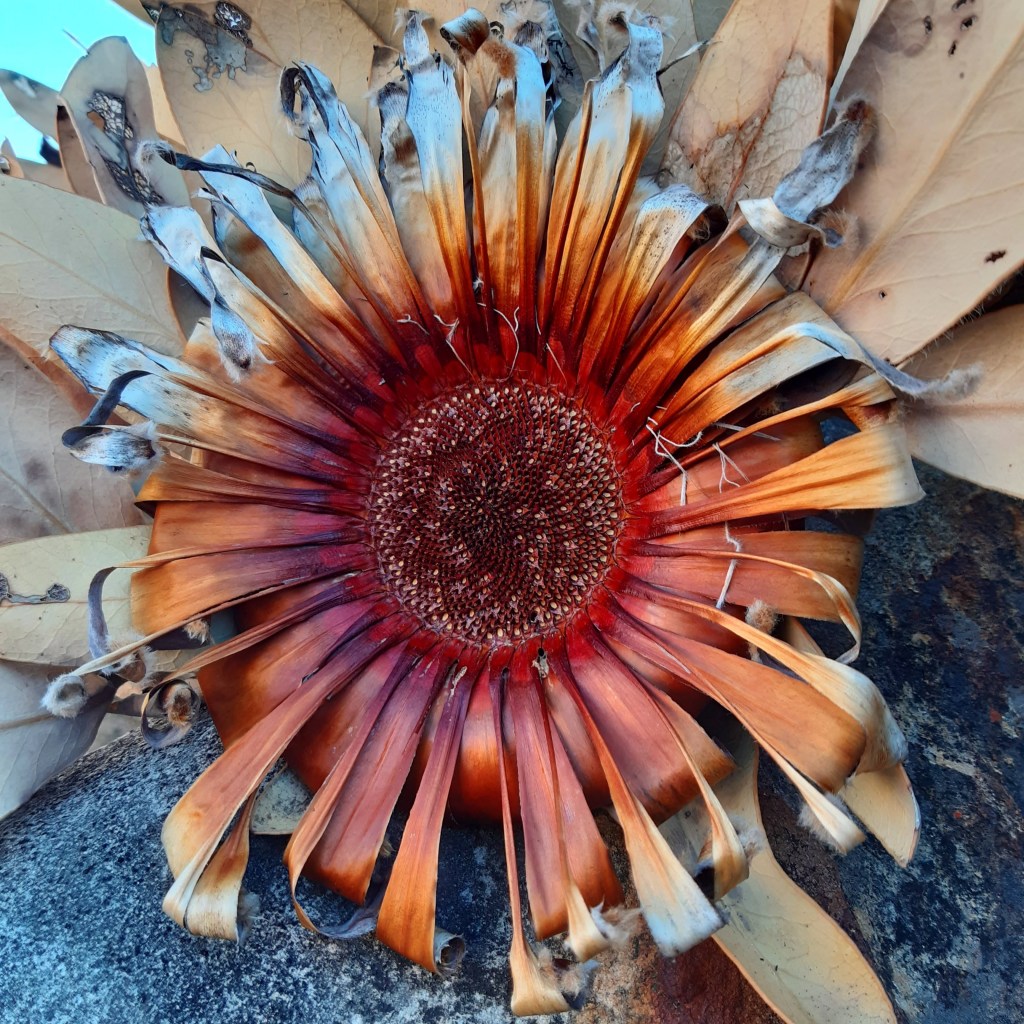
I studied and took photos of brass-coloured ex-proteas, clustered below my cave in burnt-out bush skeletons. I photographed the slanted afternoon sunshine, spotlighting bushes through gaps in the rocky outcrops in the ridge above me. Earlier I had seen several white proteas, alive and freshly in bloom, splashed along the slopes of the valley and river basin.
Up at the cave I made tea. I drank it slowly, sitting on my mattress and rolled-out sleeping bag, with a square of dark chocolate, and I looked and listened some more.
That night I cooked dinner and ate it cross-legged, watching the crags turn from a red-brick sunset castle, to a dark outline in the shape of a cartoon frog, and finally a human face in profile.
I watched stars rising, above the notches and spires in the ridge, from the bridge of the nose of the adjacent koppie. I gazed at them as they climbed slowly; I saw one, winking and fluttering like a flare quivering at the top of its arc, threatening to fall back down to earth.
Through the night, whenever I woke, I could look out from beneath the cowl of my sleeping bag at the glowing-white marble wall of crumpled boulders on the opposite slopes. The fiery moon caught my eye from time to time. I drifted in and out of dreams I forgot. I eventually rolled over and saw the sky, now an indeterminate, paling grey-blue. Not yet a rosy tint – that was yet to come – but I reached out and checked my phone for the time. 06h15.
I lay and dozed, and lazily watched the pre-dawn light. Soon enough I got up and walked along the cave ledge to ablute, and as I turned the corner I saw the moon on its final descent to the ridge.
As my morning tea steeped and I was massaging lumps out of my single-sachet serving of instant oats, pink sunrise was gathering further south, and spilling through the saddle to the north.
Being and becoming transparent

Hiking alone gives you a basic sense of self-sufficiency. However brief and contrived the experience may be, there is a simple satisfaction in carrying and setting up a capsule home and kitchen in the wilderness, all by yourself. There is, of course, also the satisfaction of being able to navigate, to explore, and to get to places using only your body.
I took away a quiet sense of validation, which showed up afterwards in small, seemingly inconsequential moments of confidence. I spoke Afrikaans to the lady at the petrol station till, of my own volition. I ordered fast food without dithering. These things seem trivial, but they illustrate the fabric of my daily, mildly neurotic functioning.
I like to think that the kind of low-grade, survival-mode hypervigilance that I experience when present and alone in nature offers some form of immunity from overcomplicated worry. More simply put, being outside of “normal” life changes your perspective. Normal life for me is defined by the anxiety of thoughts (as my therapist likes to say, anxiety is the product of having a mind); in the wilderness, at the very least, the anxiety is somewhat externalised. It has a different quality, something like a basic awakeness. It is, perhaps, the anxiety of a fully functioning sympathetic nervous system, rather than an overactive prefrontal cortex.
I suppose what I am describing, in a typically roundabout way, is a certain form of groundedness. But more importantly, it was a feeling of expansiveness.
Simplifying one’s existence may usually be about focusing – about choosing, deciding, prioritising. But perhaps it can also be about widening the lens. There is reassurance in being pragmatic, in knowing that I can do practical things, find my way, take care of myself; there is a broader, simpler happiness in recognising that I am also capable of being quietly content, even delighted, by vacant, unshaped, unstructured, unhurried time.
In recognising the capacity for awe. For not being able to get enough of a rock face. For wanting to take in as much as possible. Except that it’s not really a taking in, but almost a dissolving into.
The philosopher and neuroscientist Sam Harris, in a conversation on non-dual meditation on the podcast Waking Up, talked about the realisation of anatta, or “no-self”, and how he saw it as important to have your eyes open during this practice. Closing them implies an inward searching – but there is no “inside”, he says; there is no self to go into. The absence of self is right there on the surface, Harris says, not someplace deep within. Only with your eyes open can you have the experience – the recognition, rather – that you are essentially looking from nothing. Or from everything.
I notice sometimes that a clear blue sky can look almost depthless. When we look at our surroundings in a certain way, we can all of a sudden lose track of the distance we perceive between ourselves and what we think of as everything else. This may be to glimpse the truth of consciousness: that this is all there is, and it is all the same.
Happiness to me is to be a pane of glass, or mirror. To imagine that in place of one’s head there is just the sky, the mountains, your friends, whatever all this stuff is; the universe, without a need to contain or be separated from its contents.
I remember in the fourth book of The Hitchhiker’s Guide to the Galaxy, there is a character called Wonko the Sane who lives in an inside-out house, which he calls “Outside the Asylum”. The Asylum is, basically, the rest of society. Perhaps I hike in order to step outside of the disordered-feeling house of everyday life, and more importantly the crazy house that is life inside my own head.
We can never really get outside of life. But around the complexity of thoughts and feelings is the simple capacity for witnessing. Maybe we don’t need to put it all down.
Whenever I return from experiences in the wilderness and journal about them, I feel a curious combination of nostalgia and subtle angst at trying to capture the broadness of the experience, to keep hold of something precious and ineffable. Perhaps it’s the tension between wanting to honour and treasure something, and being reluctant to crystallise and compress it into any sort of frame. There’s an impatience that comes with attempting to get it all down on paper – or is that the impatience of “real life” wanting to continue? – before, I imagine, it all flies away.
The metaphor that always comes to mind is of a beautiful skylight closing.
But perhaps it doesn’t have to. Inevitably, I will return my eyes to other things inside the house. But the skylight is always there.
 All & None of the Above