

I recently got back from a hiking trip in Europe. My husband and I walked over 400 kilometres of trail across the Austrian Alps and the Dolomites in Italy. We spent just over three weeks in the mountains, covering an average of 20km per day. We alternated between camping and sleeping in refuges, which allowed us to experience a great combination of freedom and comfort. The trails were well-built and -signposted, the views were spectacular, and we got to walk in nature all day, often with the added luxury of having someone else cook our dinner for us. It was a joy. But given that we were still carrying our clothes, food and camping gear up mountain passes with steep gradients, there were naturally some sections of struggle.
When I say struggle, I don’t mean it in the extreme sense. Nobody broke any bones, we didn’t starve or dehydrate, and we didn’t have any real “epics”, apart from getting caught in a few thunderstorms. In the context of the hike, I mainly mean physical challenge and a few particular scenarios where I was “on edge”.
Specifically, we went up certain slopes that were both very steep and made of scree, or small loose stones. We were on sketchy ground, with a long drop-off to a rocky valley far below us. Each step was slow and effortful because we had to place our feet carefully, and then expect them to slide backwards. For those readers who don’t sign up for this sort of thing for fun, it basically feels like trying to get up a 45-degree travelator which is going in the opposite direction and is also made of gravel (note: I know hills are never as steep as they seem. These were probably 30 degrees max).
Imagine it, if you will: your heart is already racing because you are going up a hill, and not a gentle one. Your calf muscles are burning because you’re literally on your toes (unless, unlike me, you have been blessed with flexible Achilles tendons). Your trekking poles are dragging along noisily over rocks and dirt and getting in the way. You are trying to get up a mountain which seems to be actively trying to throw you off it. And you are afraid of slipping and falling because it could mean ending up in the valley floor.
In short, it feels like you are fighting – against gravity, against ground that won’t stay still, against the whole damned mountain.
So, here’s the thing: 1) hiking up a steep rocky slope is physically hard work, and 2) having a fight-or-flight response to the (more-or-less) real possibility of falling down a mountainside is surely normal. But is it possible to experience these things without getting worked up? And by worked up, in my case I mean feeling panicked, frustrated and frankly a little pissed off.
There are moments in life where you step back and ask yourself why you’re getting into such a state over something you chose to do in the first place. More broadly, though, I thought of this as an opportunity to reflect on something bigger: that we can be in a certain amount of discomfort or pain, or generally in a bad situation, without suffering.
In essence: Assuming we are not being faced with a mortal threat, and leaving aside extreme and lifelong hardship for now, is it possible for something to be challenging without it being a “fight”? Can something be a struggle without us struggling with it?
The struggle is real (in your head)

When something feels like a struggle, it usually implies two things. Firstly, we don’t like it. It is painful or uncomfortable or frustrating or inconvenient. Secondly, and more importantly, there is some sense of us pushing or fighting against it, or turning away from it. What often happens when we experience push-back? We push back. We resist.
I place my foot down and it slips backwards; I react by moving faster, which soon turns into scrambling. I grip more and more tightly onto things, including rocks, which in turn start coming loose and tumbling down, which gets me even more scared. In short, not only am I making myself work harder, I am also getting myself all worked up in the process. Clearly, then, a large part of struggling is in our response to whatever we feel we’re struggling with.
How can be break this down? The first thing is to notice our feeling tone or “attitude” towards the unpleasant situations or sensation. As we’ve established, we don’t like it; but there’s more to it. What happens in between a stimulus and our response to it is that we label it – we make an evaluation, often without much thought or conscious awareness. These evaluations in turn trigger thoughts and feelings about the situation, which then prompt our response. Our response can be both external (behaviour) and internal (thoughts and emotions).
In other words, there is a difficult situation, and before we do anything about it, we make some kind of judgment about that situation, which triggers a whole lot of internal processes. For now, let’s focus on the internal processes that are not entirely instinctive or reflexive – in other words, what we might call the “self-talk”.

Photo by Jen Theodore on Unsplash
When times are tough, do you find yourself moving quickly from thinking “This is so terrible” to thinking things like “This shouldn’t be happening” or “This is wrong”? You might then go into interrogation mode (“Why is this happening?”); then, you might feel like a victim (“Why is this happening to me?”); then you get angry, or even ashamed (“This always happens to me”, “I’m so pathetic…”).
There are three things to highlight here. One is to notice how negative self-talk can morph from being about one small thing, to being about the entire situation, and finally to being about us, or us against the world. Two, that the self-talk is a large part of the struggle response, and of our suffering in general – that is, the suffering we “add” through our assessment of situations, events, sensations, or whatever is affecting our present experience. And thirdly, in the case of the struggle response in particular, the crux is that usually we have assessed things as being not just unpleasant but unacceptable in some way.
The struggle switch
One way of thinking about all this is using a metaphor I recalled from reading about Acceptance and Commitment Therapy (ACT). Dr Russ Harris, an ACT therapist and author of The Happiness Trap, explains the idea in this video. Essentially, when our struggle switch is “on”, we react to an uncomfortable situation in all the ways I just described above: We label it as wrong, we get worked up about it, and we resist or fight it.

Photo by Justus Menke on Unsplash
Importantly, Harris uses the switch concept to explain the “emotional amplification train” we get onto when we have negative thoughts and feelings about our negative thoughts and feelings – for example, getting anxious about being anxious.
When your struggle switch is “off”, on the other hand, your response to an unpleasant situation or an uncomfortable emotion is more neutral. As Harris explains, it’s not that you ignore it, like it or approve of it; you just decide that you are not going to struggle with it. Struggling with a situation takes mental and physical energy and time – with our switch off, we can rather invest that energy in doing more productive things.
More importantly, when we don’t struggle, we are able to recognise that situations and emotional states are temporary. To paraphrase Harris, with the struggle switch off, our feelings are free to move. When we don’t add to our anxiety, it can more easily run its course and dissipate.
There is a sense of non-attachment with this approach – in a way, you are choosing not to engage with your emotions, or at least not to get so involved with them. This, I think, points to one of the obvious reasons we do default to having our struggle switch “ON”, despite how energy intensive it is, which is very simply that we want to do something about it. We believe we can be more productive by “fixing” the situation, and our feelings, in the moment. We will come back to this soon, because there’s something even broader at the heart of it. For now, let’s expand on what it looks like to not struggle with something.
Photo by sum+it via Pexels.
The antidote
In the middle of one of those rough moments on the hike, when I noticed that my struggle switch was most certainly “on”, something else came to me that I had read somewhere. I couldn’t remember where it was from, but it seemed very relevant, and it was essentially this:
When you notice you are struggling, stop and ask yourself: What is it about this situation that I am not accepting?
This links clearly back to the struggle switch idea because, as explained, we fight with a situation when we judge it as unacceptable. So, if non-acceptance is the trigger, could acceptance help us to “tap out” and switch off?
What could this look like in practice? Rather humbling, as it turns out, because it often involves recognising certain “realities” that should be blindingly obvious but that we all lose sight of because we are human.
Accepting situations
Let’s go back to my original example of hiking up a steep and slippery path. What was I not accepting in that situation, which was getting me so worked up? How about the reality that when you put your foot down on loose rocks, particularly on an uphill, you might slide backwards? In other words, I thought, maybe what I’m not accepting is that gravity works.
Once I’ve recognised how futile it is to fight against gravity, what are some alternative ways of thinking about the situation which involve less resistance and more acceptance?
- Can I accept that every step I make is likely to slide? Could I actually anticipate my foot sliding without getting annoyed or excessively nervous?
- Rather than gripping onto everything so tightly to try to stop it from slipping – and therefore risking hanging onto the one rock that does go down the mountain – what if I assume that everything is going to move? Will this allow me to tread more lightly and be more agile?
- Can I accept that it might take me about double the usual effort to go forwards? And that this isn’t about my level of fitness but about physics, as it were?
Let’s apply the struggle concept much more loosely to another, more familiar example. Say I’m getting frustrated by being stuck behind a slow driver. What might I not be accepting here (apart from the speed limit)? Perhaps that other road users have timelines, agendas or carloads that are different from mine. Personally, I might also be struggling to accept that I am angry at myself for leaving the house too late and putting myself in a situation where I feel rushed (lately, I sometimes ask myself whose fault it is that I’m in a hurry). Perhaps more neutrally, what I’m not accepting is that it takes the time that it takes to drive somewhere, and unfortunately other drivers have to use the road too.
So there we have a range of realities, from universal laws to the reality that other people do things differently to us. And the idea is that whatever the situation, we should try to accept the reality of it and work within, rather than against, its bounds.
Across these scenarios, one essential factor that is likely to have come up in most readers’ minds by now is control. Should we only accept the things we cannot control? And what about “realities” that we do not like?
Why we struggle with the struggle switch

Let’s be honest: it feels wrong to accept things going badly, doesn’t it? Indeed, at the very heart of our tendency to struggle may be our desire for control. We fear being powerless, at the mercy of others or an uncaring universe. Aside from fearing that we may be unable to help ourselves, we may also fear that a bad situation will never change.
More philosophically, many of us have been raised by a culture whose mythology is basically that people get what they deserve, and therefore if something bad happens to you, it must be your fault somehow. Perhaps the bigger and more uncomfortable realities that we are unwilling to accept are that shit happens, to good people and despite our best intentions, and that nobody escapes suffering. An interesting thing to reflect on is that we have no control over what culture we were born into, and yet it may have been that very culture which led us to believe that we have to be in control and that everything happens for a reason. Cultural differences aside, though, humans all have some need for agency; so, to state it bluntly, we are wired to get peeved about stuff we can’t control.
With that in mind, an important point: accepting a situation does not preclude us from doing something about it. As with the struggle switch, acceptance doesn’t mean we now like or approve of the circumstances we’re in; rather, it means we choose not to invest as much energy focusing on how bad and “wrong” it is. With a bit of grace, we may even prevent ourselves from freezing up in situations that “shouldn’t be happening”. Ultimately, while we may think we only change the things we cannot accept, the reality is that we can only change something after we’ve accepted it – that is, faced it as reality.
Acceptance, then, does not mean resignation. We might accept that we’re in a difficult situation right now, but that does not mean that we are doomed to be stuck in it forever. Here, it is useful to return to Russ Harris’s point that once we accept something, it is free to move. If we exclude things like gravity, we should remember that the realities we accept are, for the most part, temporary. We might be able to change things, but things also change by themselves. Perhaps a key outcome of acceptance, then, is to get us to see flexibility as a better alternative to control.
“I’m not giving up, I’m just giving in.”
Florence + the Machine
Now let’s look at another element of our reality that we often struggle to accept, in part because we lose sight of their transience: feelings.
Accepting emotions
One key takeaway from the Struggle Switch is that we tend to compound our negative emotions, essentially by feeling bad about having “bad” feelings. By being more mindful, and avoiding the nonstop train of labelling and judgment, we can acknowledge our emotions without amplifying them.
The question, then, is: Do we include our emotional reactions as part of the “reality” that we accept – even the so-called amplified or secondary emotions? And even if emotions might not be considered “reality” because they are subjective?

Image: Twitter.
To make it more specific: In the hiking example, should I accept not just the reality that the slope is slippery and that gravity works, but also the reality that I am feeling freaked out and horrible, possibly “unnecessarily” so, and that’s OK?
They say we can’t control what happens in the world, but we can control our response to it. An important thing to highlight is the word response – we cannot always control our reactions, and that covers our emotions to a large extent (or at least our primary ones). For example, I can’t control the fact that when I perceive a threat, my fight or flight response is triggered. People who have experienced trauma cannot control, in the moment, their automatic responses to certain stimuli that trigger them. And we cannot change the fact that we have feelings, full stop.
Which is all the more reason for acceptance. One implication of which may be that we should sometimes let our feelings be. While some people have been taught that feelings should be ignored, I tend to believe that ignoring feelings is bad and therefore we should deal with them in the moment. But because this often means interrogating, analysing, and drawing inferences about them, or even comparing myself with others and how they might respond to my situation, perhaps I may be better off just saying, for example, “There’s anger. It may or may not seem out of proportion to the situation. But I’m not going to do anything with this anger for now.” This is a challenge, but it is helpful to remind ourselves once again that whatever we are experiencing is temporary, if not changeable.

Photo by Photography Maghradze PH via Pexels.
Accepting all of it
However useful the struggle switch metaphor is, the “on/off” concept did strike me as potentially somewhat binary: either you are struggling, or you are accepting. I know this is not how it is intended – it is a helpful shortcut on the whole (hey, who doesn’t like the idea of having a literal control to moderate their control freak tendencies?). I just wonder about the times when we do inevitably fall back into the “struggle trap” and then beat ourselves up about it and think we’ve failed.
When I spoke to my therapist about this concept, I wanted to explore what to do with the self-judgment. The real struggle, after all, is dealing with the internal monologue. Should I try to examine the self-talk, and work on shifting it over the long term; or should I accept it as reality, too – so that it is also “free to move”?
In response, he encouraged me to take it even wider: Accept your whole experience. To help make sense of this, he offered me this interesting perspective:
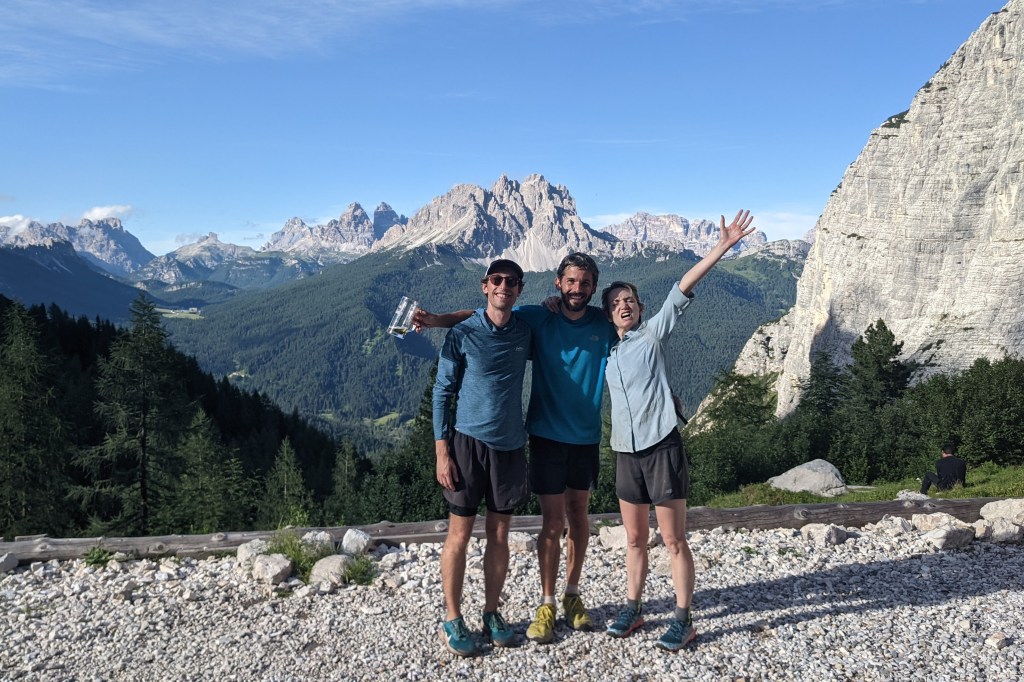
Imagine yourself telling the story of something in the past that you struggled with. Imagine it from another person’s point of view. They may notice different aspects of the story; they may interpret in a completely different way. Importantly, in telling your story, you are not only accepting it by default because it is an event that has passed; you are also recognising the integrity of your whole journey. This is your story: there is only one of you, and there is only one way for you to get up a hill, and that is your way. Your way did include some anxiety and negative self-talk. But ultimately, you reached the same outcome: you got up the hill.
As I made sense of it, accepting your whole experience is a little like bringing this “retrospective” view back into the present moment. Maybe it is a little like that trick of making light of shitty situation by saying: “Well, this will make a great story”. But instead of dismissing one’s experience, this is about acknowledging and accepting all of it, including not only the discomfort and the anxiety but all the ways in which we struggle with that anxiety.
Self-acceptance – and a parting thought on shame
Finally, all of this invites us towards acceptance of self – without putting ourselves down and without self-centredness. Having observed how much we do struggle despite ourselves, we are then also invited towards greater understanding towards, and acceptance of, others.
Sometimes the uncomfortable reality we are struggling to accept is that we have messed up. Another uncomfortable reality we may not like to accept is that we are not the centre of the universe (thinking in particular back to the example of being stuck behind slow drivers). We are unwilling to acknowledge our shadow side because this means allowing the terrifying possibility that we might be bad people. Perhaps beneath our struggle is an even deeper, more painful reality: shame.
Another thing my therapist has helped me to recognise is that we don’t have shame because we’re bad people, or even because we are somehow weaker and more shame-prone than others; we have shame because we have minds, and because we live in human societies. I am not saying that shame is not damaging and that we should not work with it over the long term in order to heal ourselves and our communities. Rather, perhaps there is an opportunity to view it differently, in parallel and in a way that may begin to liberate us. Namely: we can accept that we are experiencing shame, without believing what that shame is trying to tell us. And this can apply to negative self-talk generally.
In a sense, I can accept the reality that my mind is telling me stories, without “accepting” – that is, buying into – those stories as truth.
Ultimately, could it be that we can accept everything and hold onto nothing?
 All & None of the Above