

I arrived in Jaipur on a balmy June evening after a short flight from Dehradun. I remember the arrivals hall being brightly lit by 7pm sunshine as I picked up my backpack from the baggage carousel.
I ordered my taxi before I walked out of the airport building. The game of getting around in Indian cities is a topic of its own, but at this point in my journey I had decided on one rough rule: whenever I arrived in a new place with my luggage, I would take an e-taxi rather than an auto rickshaw. There were several reasons for this: one, you don’t have to negotiate the price. Two, you don’t have to negotiate the destination (I had heard stories). Three, you don’t necessarily have to talk to the driver.
I stood outside, slowly pacing back and forth and glancing at my phone from time to time, in the hope that this would signal to other taxi drivers that I was busy and/or “taken”. This didn’t always work, of course – I would still get approached at train stations, tourist hotspots, or sometimes whenever I was just walking down a busy street. By the end of my trip, I would show them the price my e-taxi had quoted and see whether they’d beat it. Often, they would simply move on. Other times, they tried to tell me that the price I’d been quoted by my app was wrong and I would end up paying much higher because the driver would demand some sort of other payment to cover some or other parking fee or traffic tariff.
As it happened on this occasion, my Jaipur driver needed me to pay for his airport parking fee. This happened after he called me, tried unsuccessfully to communicate something that was probably about which side of the Drop-n-Go area I was supposed to be waiting at, and then missed me and went into the short-term parking lot across the road. Whether I should have been more specific about my pickup location, or whether all e-taxis have to use the parking area, I’ll never know. But here was the first time I observed something that proved to be somewhat of a trend in my experience:
Not only did e-taxi drivers speak less, full-stop, they also seemed to speak less English than auto rickshaw drivers. This works fine in most cases, because not talking does seem to be the modus operandi when using e-taxis. But it doesn’t work so well if you do actually want to have a conversation with your driver and you’re not local.
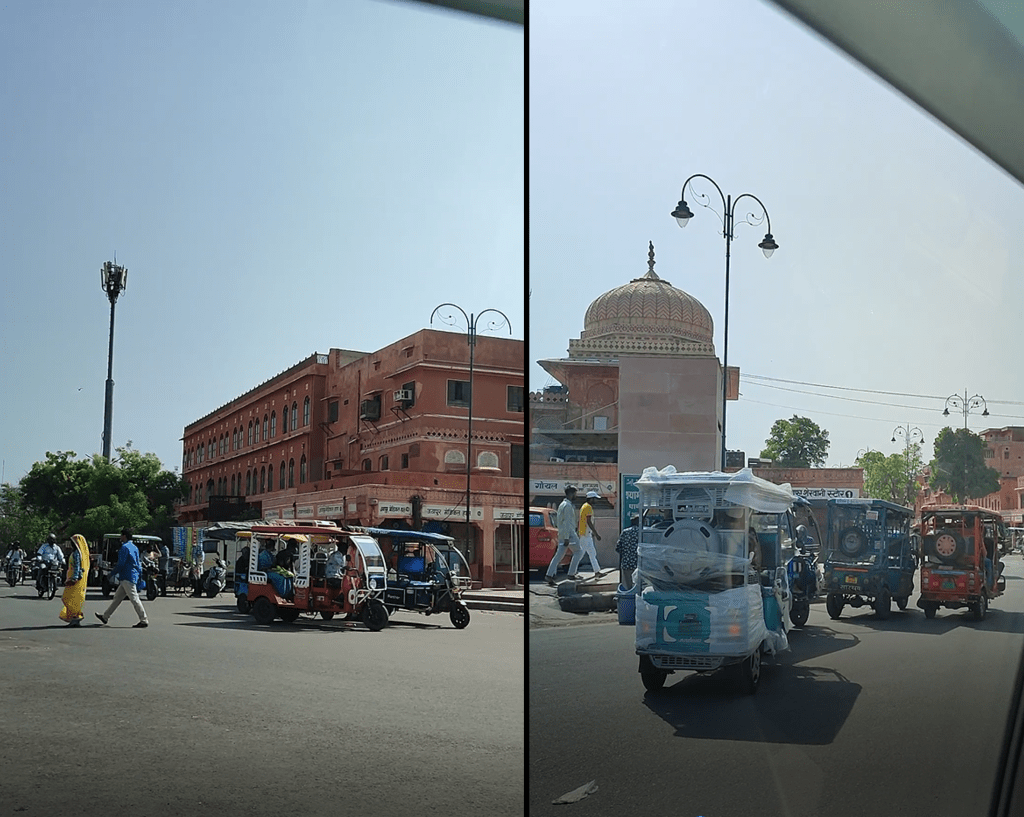
I had tried to learn a little bit of Hindi before my trip. However, the majority of my time on Duolingo had been spent on the (admittedly fun) process of figuring out a new alphabet. So apart from patting myself on the back for being able to recognise the lettering on the airport building pillars, which spelled out “JAIPUR”, I was confronted with the expected challenge of not really being able to have a meaningful dialogue with a stranger, beyond some basic phrases.
So when my Jaipur taxi driver, after staring at me in the rear view mirror for a good few blocks, suddenly asked me a very specific question, which contained none of the vocab I had learned during my extremely limited coursework, I was a little stuck. I deployed a cursory “Kyaa aap angrezii bolte hain?” (“Do you speak English?”), got a clear No signal, and did a lot of umming.
After a short while, he pulled out a bank note and waved it around, which puzzled me further. I tried guessing what he was asking (“What is my country? No?”), then wondered if he wanted me to pay him in cash. We tried some more charades until defaulting to Google translate. He spoke into his phone, tapped it a few times (somehow keeping the car on the road this whole time), and finally held it up to show me the translation: “What money does your country use?”
He was literally asking me about bank notes.
“Oh!” I said brightly, bizarrely relieved (if only all small talk could be like show-and-tell!). “The South African Rand – here…” and I opened my purse and pulled out a pink 50-rand note from back home to show him. In response, he pulled out a 50-rupee note. We did the whole statesman recognition exchange – “Ah, Nelson Mandela!”; “Yes, he’s on the back of all of them, like Gandhi is on all of yours.” I may or may not have started attempting to tell him about the Big Five (the animals on the other side of each South African bank note) when he moved the conversation swiftly along by making some clear back-and -forth pointing gestures.
He wanted to do a swap. 50 ZAR for 50 Rs.
Spontaneously I started laughing. Surely it was obvious that this was not quite a fair trade? Leaving aside the fact that they don’t usually include the words for “exchange rate” in Level 0 Hindi, how was I meant to ask him if he was being serious? When he didn’t change his stance despite my “Huh?” non-verbals, I decided not to turn this into a bureau de change negotiation and accepted the swap. Oh well, I told myself, it’s just fifty bucks. Clever bugger.

I sat back, bemused, and faintly wondering what I was missing. I had been warned about various scams in India, but this was something I hadn’t expected. Was this something that happened often around here and I just hadn’t heard about it? Was this guy just particularly ingenuous? Was he honestly just a collector of different banknotes? In the moment, part of what made me let it slide was that I just couldn’t quite believe it was worth his while to take that amount of money to the nearest bureau to pocket the difference.
My mind ran rings around this, wondering if he was somehow in cahoots with the parking lot guys (fifty rupees was exactly what the short-term parking had cost), but mainly wondering whether there were other people out there, with stronger currencies, who fell for this because… they didn’t know the exchange rate? Surely not.
When I told the story later to two guys I met at my hostel, one of whom was from India, they were unanimous that this guy was indeed a clever trickster, taking regular trips to some currency exchange place with a whole portfolio of small notes from a dozen different countries. If you try it with enough people, it all adds up.
Reflecting on this sometime later, I considered that what my mind was probably reluctant to admit was that, in all likelihood, this sort of trick works because most other people are like me – or rather, I am like most people. That most people can see they are being ripped off, but to the tune of an amount of money that doesn’t mean enough to them to make a fuss about it, and so they let it slide.
Maybe what’s really going on is that I can afford not to care too much about losing fifty bucks (obviously I can afford it – I’m the Western tourist after all), but that’s also kind of uncomfortable to admit, and so I’m willing to “lose” it in such a way that I feel I am giving it away. The payoff for me is that I get to think of myself as savvy (“I see what you’re doing…”) as well as somehow magnanimous (“Go on then, I’ll give it to you.”). And I’ve now got a funny story to tell about a taxi driver in Jaipur.
Otherwise I’m just cynically overthinking the whole thing and this guy has a wall back home covered with pretty 50-buck notes from all over the world. Maybe I just completed his collection.
 All & None of the Above