
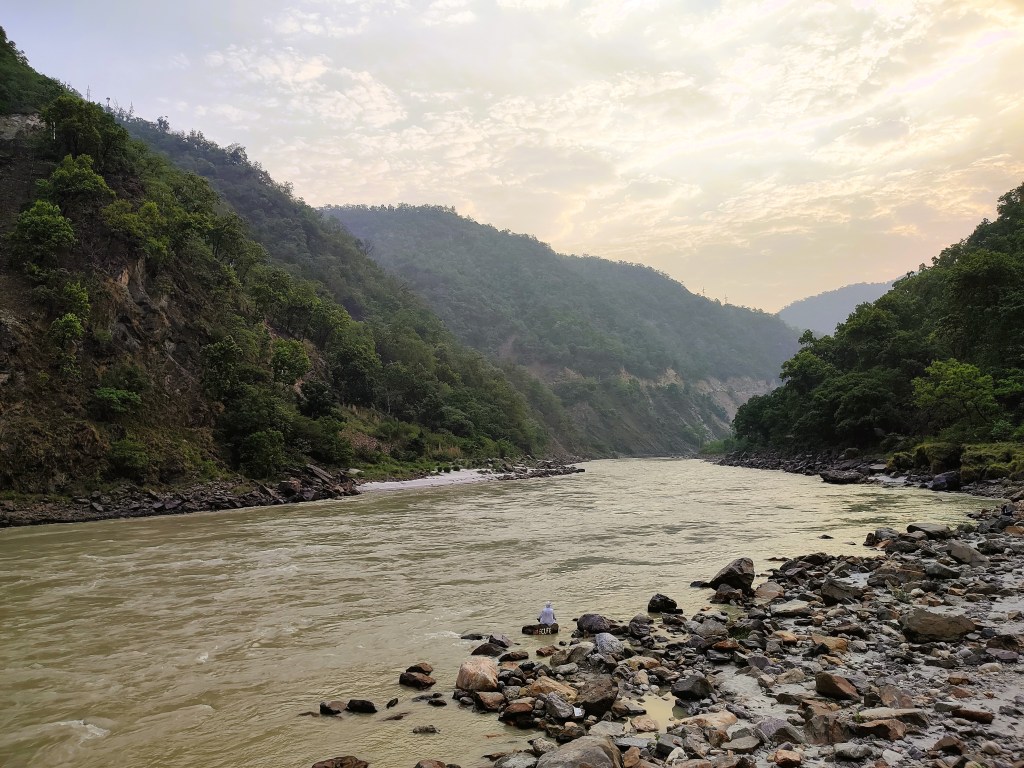
The first time I swam in the Ganges was the first morning after our arrival at the Ashram. I had set my alarm early enough to get a walk in before morning asanas, and headed upriver. I was feeling the effects of a 05h30 wakeup after not such a great night’s sleep – daytime temperatures were in the 40s and night-time was not much easier, and I still had to get used to the sound of the ceiling fan doing its utmost.
On my walk I passed a couple taking sunrise photos on the tiny wooden footbridge over a river tributary just beyond the beach and the bathing ghat. I was passed by two other walkers, and also saw someone on a scooter coasting down the track, once it had already narrowed and turned from concrete strip to dirt. Scooties, as they call them, seem to get absolutely everywhere in India. In a part of the country where jeeps laden with rubber ducks regularly manage to pass each other on a single-lane road winding around cliffs, this is unsurprising.
I jogged part of the way back to make time. It was just after 7am and asanas started at half past, but I could feel the day’s warmth and couldn’t resist a dip. I found my way round the back of some boulders, toes sinking into the fine sand, and glanced around to see if anyone else was around. Women are advised to bathe fully clothed for modesty – I usually went in wearing shorts or tights, and either long sleeves or with my orange scarf draped over my shoulders – and there were usually many fellow bathers during the day. On this particular morning, however, I spotted only a sadhu, seated in white on a rock out in the water, deep in meditation and facing the other way. I waded in, wearing the oversized sports T-shirt that I was already overheating in.
In the Hindu tradition, the Ganges River is worshipped as the sacred embodiment of Mother Ganga, the goddess of purification and forgiveness, whose mythical descent from heaven was broken by the tangled locks of Shiva’s hair. Many know about the significance of the river for the Hindu population; I’d known of ritual bathing in its waters, and learned of the pilgrimage sites of Haridwar and Varanasi, and how the ashes of the dead are scattered in the river as a direct passage to heaven or moksha (liberation). Rishikesh, where our retreat took place, is where the river emerges from the Himalayas, before emptying onto the plains and continuing its full 2500km-long course to the Bay of Bengal.
Further downstream, the Ganges becomes a wide, sluggish, and unfortunately heavily polluted river; in Rishikesh, however, it flowed in rapids. So, one aspect of our experience of the Ganga – a rather more literal and somewhat bemusing one – was as a white-water rafting destination. Every morning, as we sat eating our breakfast in yogic silence, I would smile at rubber duck-loads of holidaymakers being hurtled down this holy river, yelling and generally having the time of their lives.
(In the heat of summer, Rishikesh is a popular holiday destination for Delhiites. It is also known internationally as the Birthplace of Yoga and there is an ashram literally named after the Beatles. So it seems like everyone is either doing a 10-week certification or paddling furiously downstream.)
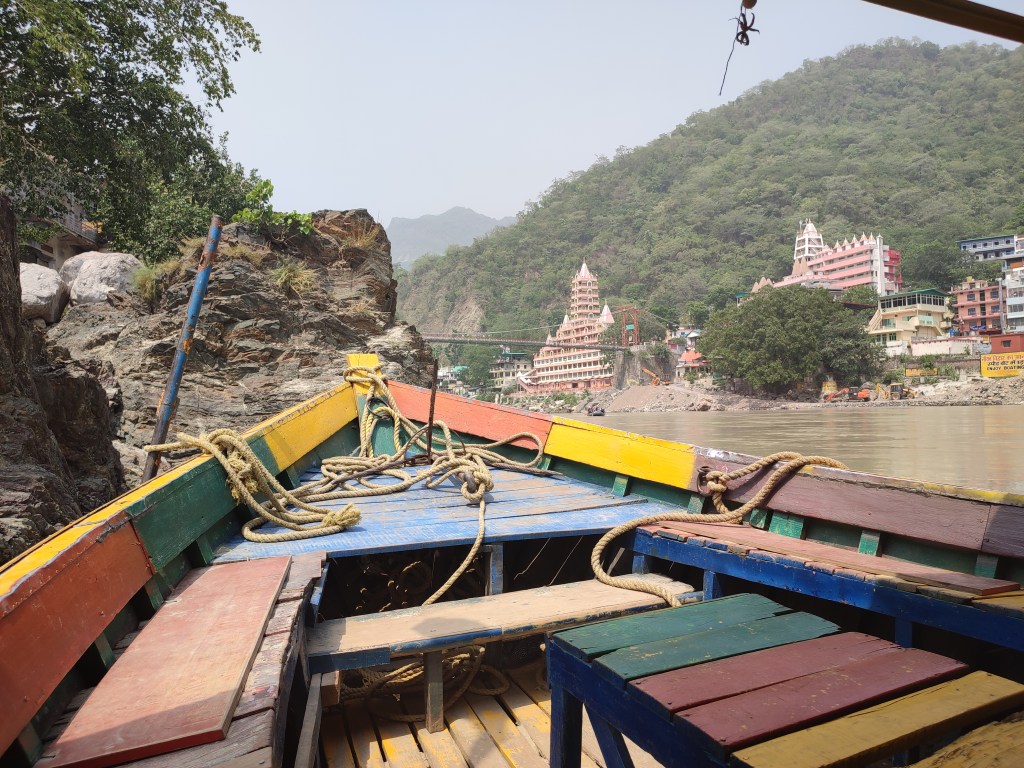
Another, more meditative experience I had of the Ganga was a moment, also over breakfast, where I sat gazing at the flow of the river for some time. The simple fact of this nonstop flow of water – this water that just kept coming, this flooding of life, this never-ending offering – struck me as suddenly miraculous. The unquestioning generosity of nature. The neutrality of it. It brought tears to my eyes as I sat there, fully absorbed in the abundance of movement and filled to the brim with simple awe. Then I shifted my gaze and looked at the riverbank, and it appeared as if the shores were moving, being dragged upriver, like a reversal of the birth of the landscape and its ever-refining soils; a retreat, a recall of the earth…
And then there were the more mythical stories of Mother Ganga, her spiritual presence and role in the lives of those pursuing liberation, and her sometimes playful way of sending “messages” to those who need them. Several days into the retreat, our host and teacher at the ashram told us about a man who came on the programme but was constantly distracted by calls and emails – he couldn’t get away from the office, thanks of course to the fact that the office can reach anyone remotely via devices. On the day they did the Ganga bathing ceremony, he took his phone along and put it down on a rock; after the ritual, he returned to find it gone. Mother Ganga had confiscated his device – and in so doing, liberated him from his distractions. He told our host a few days later that he had finally found peace.
With such stories, though quite light-hearted, the river became sentient and, to me, even a little ominous. I had of course known about the Ganga the deity – I had even read the Wikipedia page. I also knew that from a scientific perspective, this was ultimately all mythology, and part of my mind smiled at the reading of events such as things being washed away as the work of spirit, rather than just the way rivers work. But still, I was affected. With this, I was made aware of my respect for tradition, as well as my appreciation for anything mystical.
One perspective is that perhaps I am simply a little superstitious. But I could also put my feelings down to a deep reverence for nature. That moment on the river, where the simplest thing – flowing water, the force of nature – struck me as a revelation. Maybe this is it: if we were truly awake, would we not stand in awe, both in admiration and in profound appreciation of our own powerlessness? Would we not feel 100% implicated in all of the laws of the universe, which we hardly understand, at the same time as realising how inconsequential our own interpretations of everything truly are?
Anyway. The point is that I suddenly became a little anxious about the fact that I had recently collected some Ganges water in an empty glass bottle, which had previously contained beetroot and ginger kombucha, which I had bought from the airconditioned tourist sanctuary that is Tattv Café in downtown Tapovan. And now I was uncertain about exactly what to do with it.
Let me backtrack a little.
On morning two or three, I had gone for another dip before morning meditation, this time taking along this glass jar to fill up with river water. My intent had been to do my own “offering” at the temple where the devotees performed their daily sunset pooja. I had learned a little about offerings, or prasad, and how Ganga water is often collected for use in these and other rituals. Doing this was, I thought, a way for me to engage in and pay tribute to a new spiritual and cultural experience. It also proved to be a source of worry, as I, a Westerner with extremely limited insight into these traditions – heck, I was even constantly corrected about the difference between yoga and Hinduism – puzzled over protocol.
By which I mean that I found myself having basic questions such as: How much water should one take? How exactly should I offer it? Should I pour it over the Shiva statue in the centre of the temple or at his feet? How much do I pour? And then: What about the rest of the water? Presumably I shouldn’t dare to pour it out, but what could I do with it? Had I taken too much? Had I been “greedy”?
One of our yoga teachers, who was South African but had years of experience and training in yoga and Eastern traditions, was very reassuring when I asked her about these things. I admitted how awkward I felt about having all these questions (I could have gone on – was it OK that the water was standing still, at room temperature (the temperature of our rooms, by the way, meant that if you wanted your slab of Lindt from Tattv Café, you had to be content to eat it with a spoon)? Was it OK to travel with it? Imagine if it broke in my bag? Gosh, I hope I rinsed that bottle out enough before taking it in…).
Along the line, I was reminded of something that our other teacher had said when helping us make sense of all these new rituals and symbols: “God doesn’t have a religion; people do.” I was well aware of all of the conceptual fretting I was engaging in, all of the intellectualising, and it did occur to me that this was all ultimately a form of clinging. On one level, I knew that the details were ultimately all meaningless, and actually it was all about me. On a more philosophical level, maybe this was kind of an education in karmic humility. One can be cynical about others’ religious or cultural beliefs in the invisible cosmic forces of justice; at the same time, there was me worrying about what it “meant” if I took water from a river without the “right” kind of reverence and respect. Here I was petrified of doing it all wrong.
In many ways I think it’s really good to be worried about doing it all wrong. It’s part of the experience of realising that, suddenly, you are the outsider. It helps reorient us to the wider world and to other cultures with humility. It is, perhaps, the only way we learn. And it is possible to observe all the inner and outer turmoil with self-compassion.
For me, it was just interesting to notice how this sacred water had suddenly become something of a worry, if not a burden. I felt even vaguely and strangely ashamed of myself. Fortunately, I had the support of my yoga teacher host, who also happens to have become a friend of mine, and the overall context of the retreat in which to be mindful as well as kind to myself.
***
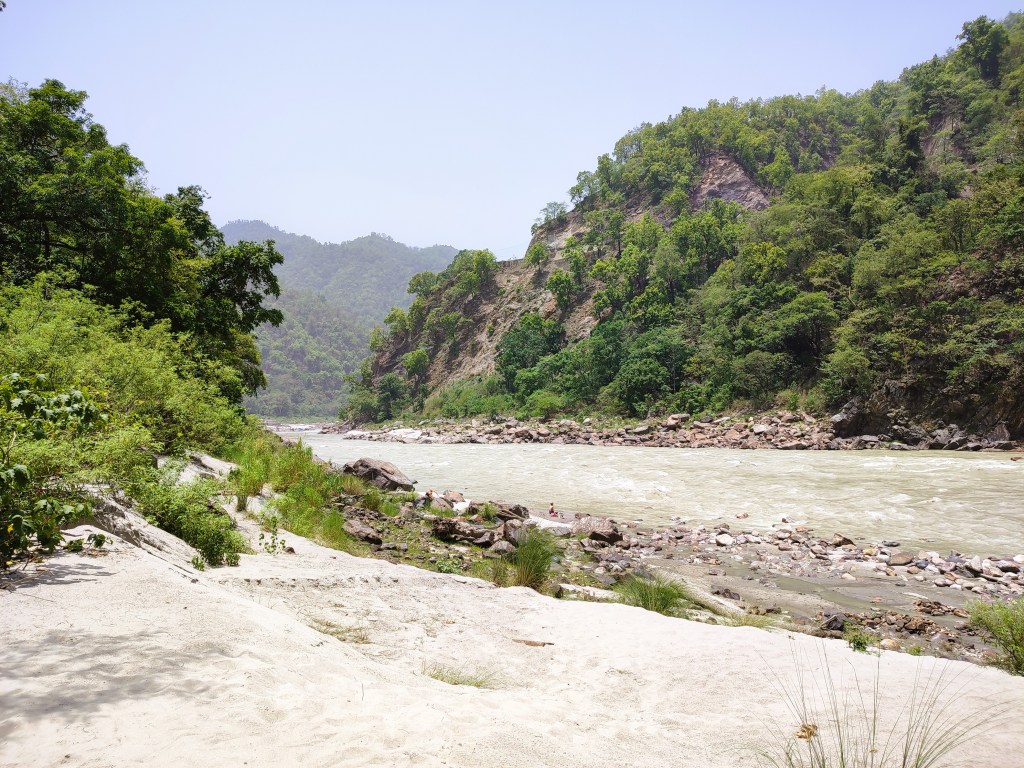
Some days later, we had our own Ganga bathing ceremony. It was another scorching day. We went in fully clothed and I was only too glad to have coverage from the late morning sun. I remember keeping my flip flops on all the way down the blinding white river bank – the sand we kicked up was dust-fine and like particles blown from a glass furnace. I remember white butterflies clustering at the edge of the river; later, we collected marble-like pebbles as mementos.
I remember throwing bougainvillea flowers into the water as an offering to Mama Ganga. I remember the hum of chanting voices above the roar of the river. We immersed ourselves three times, each time with a different prayer in mind: one, for ourselves, for something that we wished to release; two, for a specific person to whom we had a deep connection; three, for someone long departed, someone “who has been in your house”, or our ancestors – so that their souls may be at peace.
I remember now and then glancing at everyone for cues, to see where we were in the ritual process, and also to check that we were all safe – the current was strong. At later river visits, we would hold hands as we went under.
After the immersions, I sat on a rock in the water for a while; then I sat and meditated on the sand, covered up, with my rudraksha mala, turning the beads slowly between my fingers. I used the mantra “So ham”: I am that. I am that. I am that.
I am here. I am the river. I am water. I am her, I am him. I am change, I am movement.
I am that; I am light and air but also I am water and earth. I have always been connected to nature.
I thought of all the bodies of water I had swum in. The night before, there had been an electric thunderstorm, which several of us watched on our balconies with the room lights off.
* **
I took my Ganga water to sunset pooja, at my host/teacher’s suggestion, and after she very kindly took me through all of what to expect. After they rang the bells and blew the conch shell, and after receiving the candlelight blessings of aarti, I picked up my bottle and joined those gathering to enter the little temple. I knelt down and touched the threshold – a marble step – as the others did, and as instructed. I saw how the others went first to the Shiva murti (statue) in the middle of the room – there was meant to be a lingam too, the symbol of fertility or generativity associated with the deity, and, if I had remembered correctly, some sort of receptacle for water offerings. I saw the others continue round the left side of the temple, acknowledging and genuflecting or bowing to the images of other deities that hung on the walls.
I barely remember anything that I did. I opened my bottle and gently sprinkled some quantity of Ganga water on the ground in front of the Shiva statue. I closed the bottle, stood up again, and did the rounds, doing my best to take in the images of the other gods, bowing slightly, all the while clasping my bottle. I moved through in a state of hushed reverence and with a vague sense of hopefully well-contained awkwardness and overwhelm. The whole time I was feeling a mix of one part awe and ten parts blanked-out bewilderment.
Maybe this is how we’re supposed to be feeling about life and the universe at any given point of seriousness. Or maybe the whole point is to look at the bizarreness of it all and collapse into nervous laughter. At this point, I of course didn’t have the opportunity to do the latter. Instead, we went straight into the hall for evening bhajan. Which is, in fact, the perfect remedy for feeling frozen in a temple filled with beautiful but completely unfamiliar images and symbols. Confused? Here’s a hymn sheet, with Sanskrit words written out for you in Roman text; here’s a rattle; here’s your cushion. Sit down, listen to the drumbeat, join in the chanting led by the Ashram leader, and let it all carry you.
***
In the end, I took the rest of my Ganga water to the closing ceremony. It was at a separate location, a country stay where we spent the final two days of the retreat. Our two South African hosts took over the program with a short series of their own practices. We did our asanas under a thatched roof in the back garden, which extended all the way to the edge of a jungle.
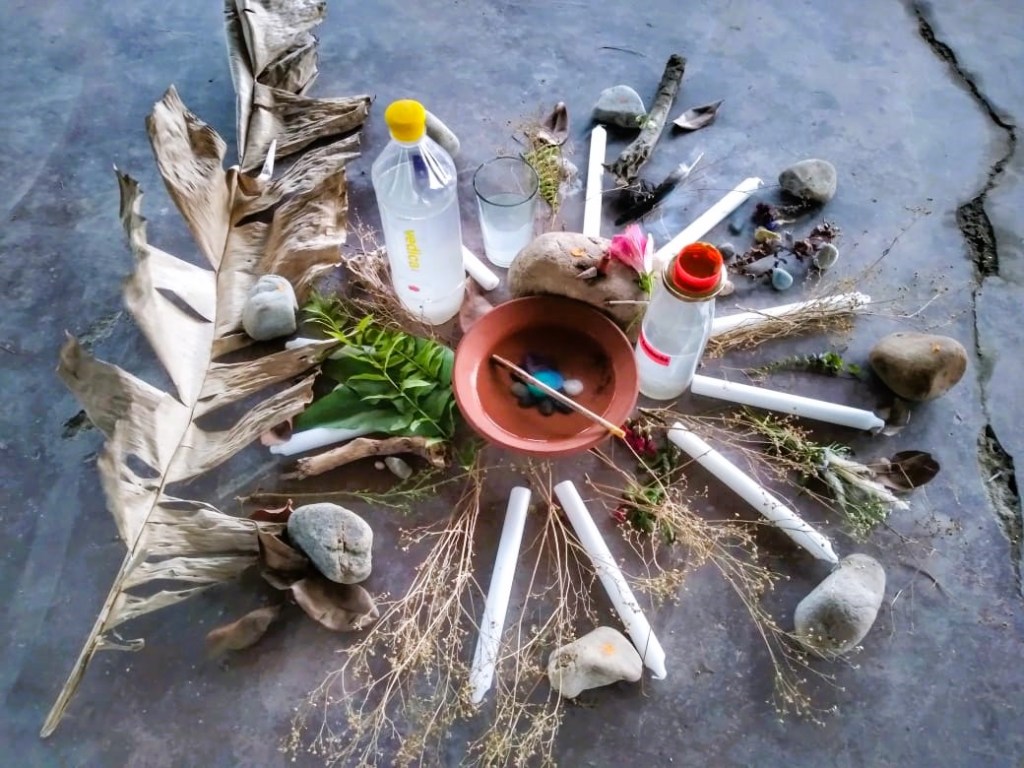
The initial idea was simply to take the offering of the water to another nature place – maybe to pour it into the river there, or onto the earth. There was the added significance of it being full moon one evening we were there. In the end, my teacher-friend poured some of it into a bowl along with some semi-precious stones, which were a farewell gift from our hosts. Thus overnight the stones would be infused with moonlight and Ganga blessings.
I was tremendously grateful to her, for not only had she helped put my mind somewhat at ease about temple pooja protocol, she also helped me find a meaningful “use” for my Ganga water. It sounds bad, but she basically helped take the burden of this special water off my hands. But the real burden was, of course, all of the mind stuff that I metaphorically infused it with.
How appropriate, perhaps, that Ganges water is cloudy. It brings to mind a metaphor commonly used in the mindfulness tradition: the mind is like clear water, but we stir up thoughts and feelings until it becomes obscured, like a flurry of glitter in a shaken-up snow globe. Ganges water, though considered sacred, is notoriously unclean. Further downstream, it is polluted by human waste; where we were, it was full of sediment, the result of recent storms upriver in the Himalaya. The water in my bottle never clarified – the silt was too fine, too dissolved.
How appropriate, too, to remember that Mother Ganga is the goddess of forgiveness, accepting all. This plays on the dual character of water – though a force of nature which can seem destructive and overwhelming, it is not fearsome or vengeful. It reshapes the landscape, and it yields; it transforms, and it nurtures.
I wasn’t the only person who brought Ganges water to the closing ceremony. I remember looking at the two bottles standing there and thinking that, at the very least, mine looked a little more “ceremonial” because it was made of glass, while the other was a plastic soda bottle (though mine still had its somewhat cheeky Kombucha label). I smiled at this – at my fixation on yet another appearance. My teacher friend had patiently reassured me of my own good intentions underlying all my anxieties around how to do this offering thing; she had also (unintentionally) shown me one final way to take it all lightly. Who cared what bottle the water goes in? It’s not about the bottle. Come to think of it, is it even about the water?
We may think of such things as enchanted objects, but how many of us have enchanted routines? How many ways are there to be attached to protocol, and to any number of symbols and ideas? How many things are there to get “wrong” in life? How many ways are there to admonish ourselves over the littlest details?
And in how many ways can we be reminded to just be like the water?
***
Diary entry
How does a river keep flowing? The source keep giving?
Each wave a little different.
Rely, rely, rely.
Trust change,
Trust movement,
Trust movement in stillness.
Only when we are still can we trust the movement.
From the beginning of time until the end.
***
End note: On Karma
The ashram experience did give me a deeper appreciation of the meaning of karma, specifically in the context of karma yoga. As a practical part of the Ashram programme, karma yoga meant performing acts of service without expectation of reward. But the broader meaning of it, or at least how I made sense of it, was to do things not only selflessly but without attachment to any outcome whatsoever (of course, this is not the same as doing something thoughtlessly). The revelation to me was that while karma might seem like attachment to outcomes – after all, it is based on the universal law of cause and effect – it actually means just the opposite. Perhaps the real spiritual test of life is not just to do good deeds with no expectation of any merit whatsoever, but more importantly to surrender to all outcomes and accept even unexpected results with equanimity.
 All & None of the Above